

You’ve been going back and forth between Motley Fool Stock Advisor and Morningstar Investor. One has a 24.5-year track record with +978.9% total returns. The other gives you the same caliber of research tools that institutional analysts use. Both cost roughly $200/year. Both cater to serious, long-term investors. And yet they could not be more different.
This comparison hits differently right now. The S&P 500 closed August at 7,686 — up 13.1% year-to-date on a total-return basis (Slickcharts) — while the VIX sits at ~15, a calm surface hiding 210 points of single-stock dispersion. The Fed is holding at 3.50-3.75%, but a September hike is roughly 60-65% priced after Chair Warsh’s Jackson Hole speech. CPI printed 3.4% YoY in July with core at 2.5%, credit spreads remain tight at 2.60%, and the CAPE ratio sits at 40-42 — the highest since September 2000. When 24.5 years of proven conviction picks (Motley Fool Stock Advisor) meets 40 years of institutional research framework (Morningstar Investor), the question is which approach gives you more conviction when the macro picture is this muddled.
Motley Fool Stock Advisor is the better choice for most investors. It delivers actionable stock picks backed by a verified 24.5-year track record — 46 ten-baggers and a 66% win rate that climbs to 92.2% on positions held 10+ years. Morningstar Investor is the better choice if you already know how to analyze stocks and want professional-grade tools to do it yourself.
Here’s the full breakdown.
Motley Fool Stock Advisor vs Morningstar Investor: Side-by-Side
| Dimension | Motley Fool Stock Advisor | Morningstar Investor | Edge |
|---|---|---|---|
| What You Get | 2 stock picks/month + portfolio framework | Research tools + analyst reports | Different products |
| Track Record | +978.9% since 2002 (vs S&P 500 +214%) | N/A (research platform, not a picking service) | Motley Fool Stock Advisor |
| Price | $99/yr (promo) / $199/yr | $199/yr (promo) / $249/yr | Motley Fool Stock Advisor |
| Methodology | Analyst-driven GARP with quant projections | Fair Value estimates + Economic Moat ratings | Tie |
| Independence | Follow analyst recommendations | Make your own decisions with data | Morningstar Investor |
| Refund Policy | 30-day money-back guarantee | 7-day free trial | Motley Fool Stock Advisor |
| Overall Winner | — | — | Motley Fool Stock Advisor (for most) |
Motley Fool Stock Advisor: The 24.5-Year Track Record
Motley Fool Stock Advisor is The Motley Fool’s flagship service, and it exists for one purpose: tell you which stocks to buy, then give you the conviction to hold them.
Since March 2002, Motley Fool Stock Advisor has recommended 526 positions. The cumulative return is +978.9%, compared to +214% for its per-position S&P 500 benchmark — TraderHQ analysis of the published trade log (data as of Aug 31, 2026). That’s not marketing — it’s a verified scorecard you can review position by position.
The numbers that matter:
- 66% win rate across all 526 positions
- 46 ten-baggers (stocks that returned 10x or more), including NVDA (+133,425%), NFLX (+43,971%), and AMZN (+34,705%)
- 191 doublers with an average time to double of 3 years and 1 month
- Winners average +1,701.7%, while losers average -44.5% — the asymmetry is what drives the portfolio
But those headline numbers need context. The service’s power comes from patience. Positions held less than 1 year have a 52.2% win rate and average 8.5% returns. Positions held 5-10 years jump to 62.9% win rate and 205.7% average returns. And positions held 10+ years? A 92.2% win rate with 4,051.8% average returns.
What makes it work:
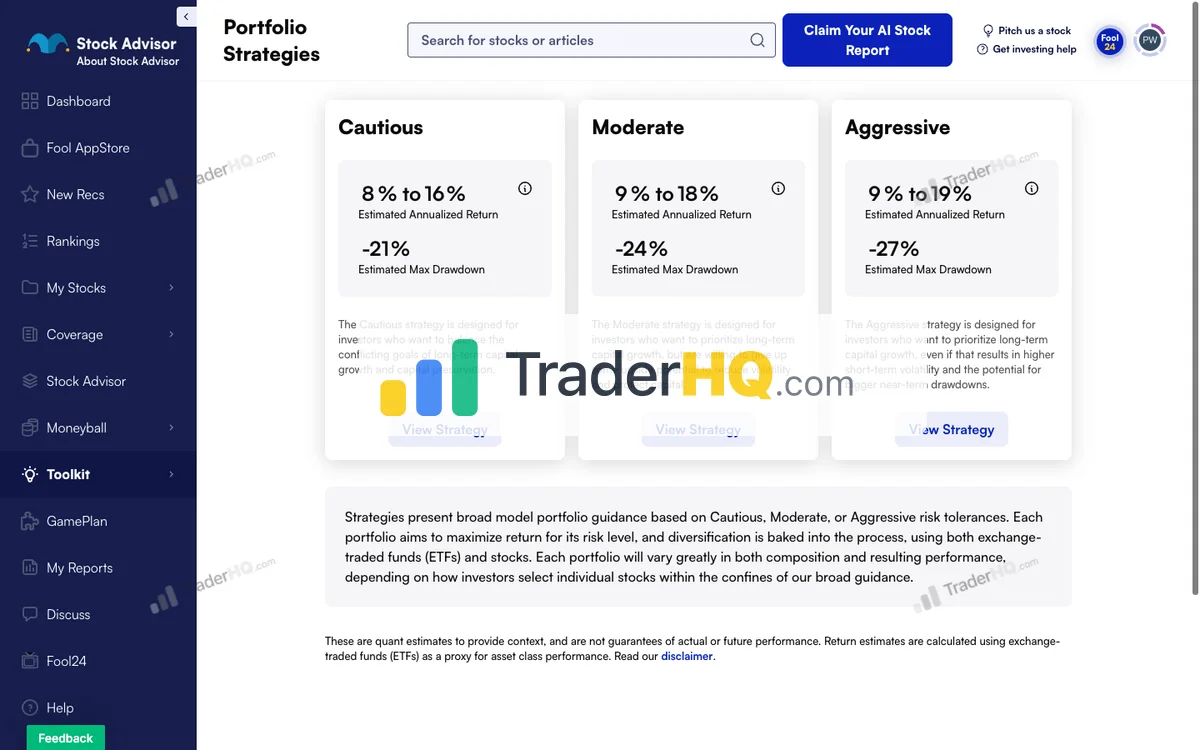
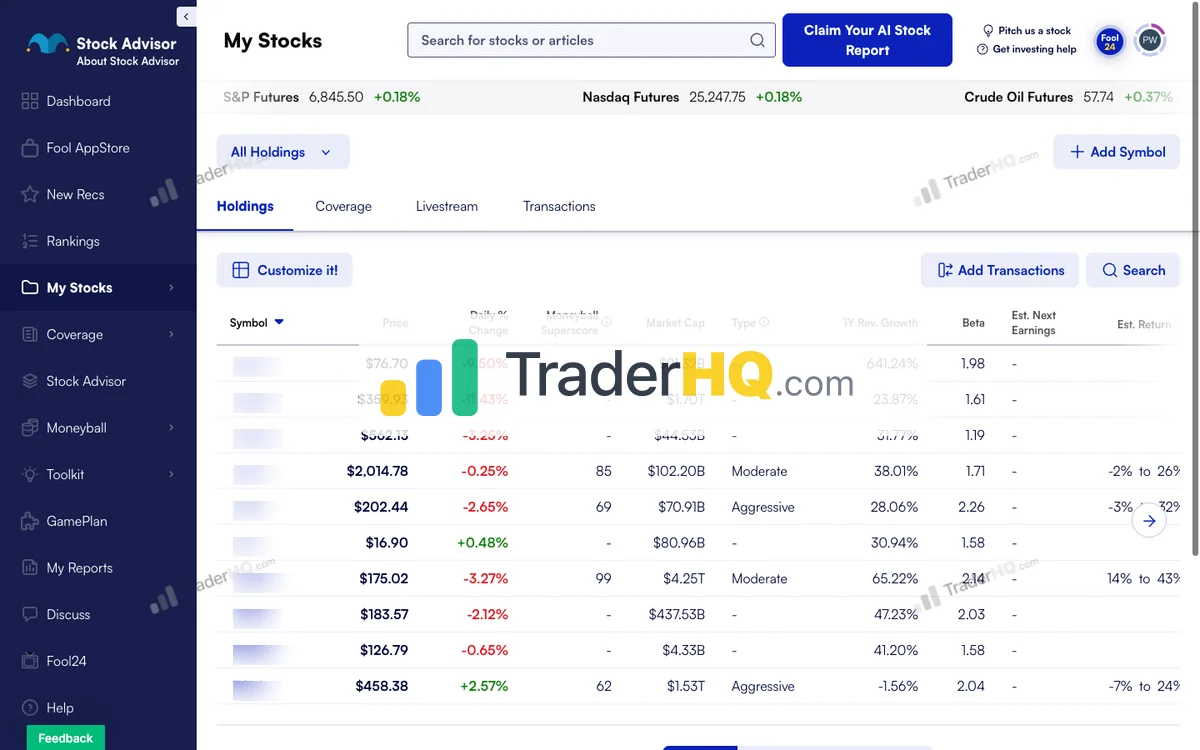
Motley Fool Stock Advisor isn’t just stock tips. You get three risk-calibrated portfolio strategies (Cautious, Moderate, Aggressive), a Foundational Stocks list of their 10 highest-conviction holdings, and a Moneyball database scoring 344 companies across 12 quantitative dimensions. Each recommendation includes estimated return ranges and max drawdowns, so you know the ride before you get on.
The trade-offs:
Expect volatility. The Aggressive strategy explicitly warns of -53% to -59% drawdowns on individual positions. The 2021 vintage picks averaged -13% returns — subscribers who joined at peak valuations experienced pain. And the upsell pressure to higher tiers (Epic at $499, Epic Plus at $1,999) is relentless.
Best for: Patient growth investors with 5+ year horizons, $25,000+ portfolios, and the stomach to hold through drawdowns. The methodology rewards conviction, not trading.
Try Motley Fool Stock Advisor — 30-Day Guarantee
Morningstar Investor: Professional-Grade Research Tools
Morningstar Investor is not a stock-picking service. That distinction matters more than anything else in this comparison.
Morningstar, Inc. has spent 40+ years building the most recognized independent investment research brand in the world. Morningstar Investor is their platform for individual investors — giving you access to the same analytical framework that institutional professionals rely on.
What you actually get:
- Fair Value estimates for individual stocks, based on Morningstar’s fundamental analysis
- Economic Moat ratings that assess whether a company has durable competitive advantages (Wide Moat, Narrow Moat, No Moat)
- Stock and fund screeners with 200+ data points for filtering securities
- Portfolio X-Ray tool for analyzing your holdings’ allocation, overlap, fees, and risk exposure
- Unlimited analyst reports with continuous coverage on thousands of securities
- Star Ratings for mutual funds and ETFs, measuring long-term outperformance potential
Morningstar Investor doesn’t tell you “buy NVDA on Thursday.” It gives you the tools to figure out whether NVDA (or any stock) is trading below fair value, whether it has a defensible moat, and how it fits within your existing portfolio. The difference is capability versus dependency.
What sets it apart:
Morningstar’s methodology emphasizes long-term value over short-term momentum. In a market where the CAPE ratio sits at 40-42 — the highest since September 2000 — and the VIX rests at ~15 with a September Fed hike roughly 60-65% priced, having a disciplined framework for assessing fair value isn’t optional. It’s essential. With the S&P 500 up 13.1% year-to-date despite massive sector rotation underneath, Morningstar’s Fair Value anchoring helps cut through surface-level noise. Their analysts are independent from other Morningstar business units, reducing the conflicts of interest that plague Wall Street research.
The trade-offs:
There’s a learning curve. This is not a “set and forget” service. You need to invest time understanding how Fair Value estimates work, what Moat ratings mean, and how to use the screeners effectively. And because Morningstar Investor doesn’t give you specific buy recommendations, the decision-making responsibility stays squarely on your shoulders.
There’s also no performance track record to evaluate. You can’t look at a scorecard and say “Morningstar’s picks returned X%,” because there are no picks. The value is in the quality of the research and your ability to apply it.
Best for: Self-directed investors who want research tools, not stock picks. If you enjoy the process of analyzing companies and making your own decisions, Morningstar Investor gives you professional-grade ammunition.
Try Morningstar Investor — 7-Day Free Trial
The Key Differences That Actually Matter
Picks vs. Tools: The Core Divide
This is the question that resolves the entire comparison. Motley Fool Stock Advisor tells you what to buy. Morningstar Investor helps you figure it out yourself.
If you want someone to do the stock selection work for you — and you want that work backed by 24.5 years of verified results — Motley Fool Stock Advisor is the clear answer. The 526-position track record with +978.9% returns isn’t theoretical. It’s a real scorecard with real picks. You log in on the 2nd and 4th Thursday of each month, read the thesis, and decide whether to buy.
If you want to build your own analytical muscle — and you’re willing to invest the time to learn how Fair Value estimates, Economic Moat ratings, and portfolio analysis tools work — Morningstar Investor gives you research infrastructure that no stock-picking service can match. You’re not following anyone’s recommendations. You’re running your own screens, reading independent analyst reports, and building conviction through your own research process.
Accountability and Track Record
Motley Fool Stock Advisor publishes every pick and its return. You can see the winners (NVDA +133,425%) and the losers (SKLZ -99%). That transparency creates accountability. When 34% of picks lose money but the overall portfolio still crushes the S&P 500, you understand that the methodology works through asymmetry — letting winners run far enough to offset the inevitable losers.
Morningstar Investor has no equivalent accountability metric. Their Fair Value estimates may prove accurate or inaccurate over time, but there’s no systematic scorecard tracking the outcomes. The value proposition is the quality and depth of the research itself, not a performance benchmark.
Cost and Value
At $99/year (promotional rate) or $199/year (regular), Motley Fool Stock Advisor is cheaper than Morningstar Investor’s $199/year (promotional) or $249/year (regular). Given that Motley Fool Stock Advisor also delivers actionable picks with a proven track record, the value proposition per dollar is hard to argue against.
That said, comparing cost directly is slightly misleading. Morningstar Investor gives you a research platform you can use to evaluate any security — not just the ones on a recommended list. For investors with diverse portfolios spanning stocks, ETFs, and mutual funds, the Portfolio X-Ray tool alone could justify the subscription.
Time Investment Required
Motley Fool Stock Advisor is designed to minimize your time commitment. Two picks per month arrive with a complete thesis, risk classification, and quantitative projections. The Portfolio Strategies framework tells you how to allocate across Cautious, Moderate, and Aggressive positions. The Foundational Stocks list tells you where to start. You could realistically implement the strategy in a few hours per month.
Morningstar Investor requires significantly more time. Learning to use the screeners effectively, interpreting Fair Value estimates in context, understanding what a Wide Moat rating actually signals about a company’s competitive position — all of this takes weeks or months to develop. The payoff is genuine analytical capability. But if you’re looking for efficiency rather than education, the time investment may not match your goals.
The Current Market Context
With market dispersion at 210 percentage points in 2026 — top 20 S&P 500 holdings averaging +168.7% while bottom 20 sit at -41.6% — both services have strong arguments. Motley Fool Stock Advisor’s analyst-driven quality approach helps you identify which stocks to own in an environment where Energy is up +38.4%, Technology +24.1%, and Basic Materials +20.4% (Finviz, Aug 31). Within tech alone, memory and storage names have surged from +162% to +560% this year while enterprise software and ad-tech names have fallen 20-64% from their highs. That kind of divergence rewards precisely the stock-by-stock analysis that Motley Fool Stock Advisor’s team performs.
Morningstar Investor’s Fair Value framework helps you avoid overpaying in a market where the CAPE ratio sits at 40-42 — the highest since September 2000. With CPI at 3.4% YoY (core 2.5%), the Fed holding at 3.50-3.75% with a September hike roughly 60-65% priced, and payrolls stalling, independent fundamental analysis anchored to company-level cash flows becomes the anchor investors need when the macro picture sends mixed signals. Credit spreads at 2.60% suggest the bond market isn’t pricing in crisis, but the 210-point gap between this year’s winners and losers tells you the index average is hiding the real story.
Both services favor quality and long-term discipline. The question is whether you want the picks done for you or the tools to do them yourself.
How to Decide
Choose Motley Fool Stock Advisor if:
- You want actionable stock picks you can act on immediately
- You value a proven 24.5-year track record over building your own analytical skills
- You have a 5+ year investment horizon and can hold through volatility
- You want a complete portfolio-building system, not just research data
- You prefer simplicity: 2 picks per month, follow the framework
Choose Morningstar Investor if:
- You enjoy analyzing stocks yourself and want professional-grade tools
- You already know how to evaluate businesses and need better data
- You want to assess Fair Value and Economic Moat across your entire portfolio
- You invest in mutual funds and ETFs (not just individual stocks)
- You value independence over following someone else’s recommendations
Either works if:
- You’re committed to long-term, quality-focused investing
- You understand that no service eliminates risk
- You’ll actually use what you’re paying for — that’s the variable that matters most
The tiebreaker: Ask yourself: “Do I want someone to tell me what to buy, or do I want the tools to figure it out myself?” If the first, Motley Fool Stock Advisor. If the second, Morningstar Investor. If both, you can use them together — Motley Fool Stock Advisor for ideas and conviction, Morningstar Investor for independent validation.
The Bottom Line
Motley Fool Stock Advisor wins for most investors. The 24.5-year track record with +978.9% returns, the verified scorecard of 526 positions, the 46 ten-baggers, and the complete portfolio-building framework make it the stronger choice for anyone who wants actionable guidance. At $99/year promotional pricing, the cost-to-value ratio is difficult to beat.
But Morningstar Investor is the smarter choice if you’re the type of investor who wants to understand why a stock is worth buying, not just that someone recommended it. The Fair Value estimates, Economic Moat ratings, and 200+ data point screeners give you the analytical foundation to make your own decisions with confidence. For self-directed investors, that independence is worth the higher price.
Neither service is a substitute for discipline. Motley Fool Stock Advisor’s methodology requires holding through 30-50% drawdowns without flinching. Morningstar Investor’s tools require the time and effort to actually use them. The best service is the one you’ll follow consistently — not the one that sounds better on paper.
Looking for a pick-based alternative to Morningstar? See how Stock Advisor stacks up against Seeking Alpha Premium or Alpha Picks. If you’re comparing Morningstar’s newsletter services instead, check our Stock Advisor vs Morningstar StockInvestor comparison.

Motley Fool Stock Advisor Performance
The Motley Fool · 526 picks · 25 years · Updated Aug 31, 2026
| SA Return | S&P 500 | Alpha | Win Rate |
|---|---|---|---|
| +979% | +214% | +765% | 66% |
S&P 500 shows what you'd have earned buying the index on each pick date instead. Same timing, fair comparison.
| SA Multi-Baggers | 10x+ | 5x+ | 3x+ | 2x+ |
|---|---|---|---|---|
| Count | 46 | 91 | 128 | 191 |
| SA Asymmetry | Avg Winner | Avg Loser | Ratio |
|---|---|---|---|
| Return | +1.7K% | -44% | ~38:1 |
Best Performers (All-Time)
| SA Pick | Return |
|---|---|
 BKNG Booking Holdings | +22K% |
 AMZN Amazon | +35K% |
 TSLA Tesla | +16K% |
 DIS Disney | +6.1K% |
 MME.DL MME.DL | +4.3K% |
 CTAS CTAS | +4.6K% |
 NVDA NVIDIA | +133K% |
 SHOP Shopify | +4.6K% |
 AAPL Apple | +6.5K% |
 NFLX Netflix | +44K% |
The multi-bagger pipeline. 191 doublers → 91 5-baggers → 46 10-baggers. About 24% of doublers become 10-baggers with enough time.
See All Stock Advisor Recommendations →Latest Stock Advisor Picks
Tickers masked to protect subscriber value. Recent picks need 3-5+ years to demonstrate thesis.
| SA Pick | Return |
|---|---|
**** Cloud Monitoring | +97% |
**** Chip Manufacturer | +85% |
**** Infrastructure Construction | +63% |
**** Growth Company | +51% |
**** Growth Company | +41% |
**** E-commerce & Cloud Giant | +28% |
**** Growth Company | +23% |
**** Convenience Stores | +19% |
**** Growth Company | +18% |
**** Growth Company | +16% |
Lessons from 2005. 16 picks that year averaged +8.4K%. Best performers often come from buying during uncertainty—when conviction feels hardest.
Stock Advisor Win Rate by Holding Period
| Hold Time | SA Win Rate | Avg Return |
|---|---|---|
| < 1 Year | 57.1% | +16% |
| 1-3 Years | 55.7% | +11% |
| 3-5 Years | 48.8% | +23% |
| 5-10 Years | 62.9% | +206% |
| 10+ Years | 92.2% | +4.1K% |
Time is the strategy. 10+ year picks show 92.2% win rate with +4.1K% average returns. Same methodology, same picks—time transforms the results.
Stock Advisor Performance by Year
| Year | SA Picks | Avg Return | Win Rate | |
|---|---|---|---|---|
| 2026 | 31 | +10% | 57% | DDOG+97% |
| 2025 | 26 | +7% | 48% | ASML+133% |
| 2024 | 25 | +25% | 67% | AMD+186% |
| 2023 | 25 | +78% | 73% | CRWD+607% |
| 2022 | 23 | +58% | 59% | NET+495% |
| 2021 | 22 | -13% | 32% | LRCX+491% |
| 2020 | 24 | +146% | 46% | TSLA+1.1K% |
| 2019 | 23 | +56% | 70% | SNPS+259% |
| 2018 | 19 | +228% | 68% | SHOP+1.1K% |
| 2017 | 22 | +700% | 86% | NVDA+8.4K% |
| 2016 | 20 | +446% | 80% | SHOP+4.6K% |
| 2015 | 22 | +208% | 68% | CASY+839% |
| 2014 | 20 | +354% | 80% | ATVI+2.8K% |
| 2013 | 17 | +386% | 65% | NFLX+2.5K% |
| 2012 | 23 | +1.2K% | 74% | TSLA+16K% |
| 2011 | 19 | +561% | 63% | AAPL+3.2K% |
| 2010 | 18 | +459% | 83% | AMZN+2.9K% |
| 2009 | 20 | +3.3K% | 90% | NVDA+56K% |
| 2008 | 18 | +1.2K% | 89% | AAPL+6.5K% |
| 2007 | 19 | +1.5K% | 37% | NFLX+29K% |
| 2006 | 20 | +2.5K% | 65% | NFLX+25K% |
| 2005 | 16 | +8.4K% | 63% | NVDA+133K% |
| 2004 | 17 | +6.0K% | 59% | NFLX+44K% |
| 2003 | 17 | +229% | 65% | PHIN+1.4K% |
| 2002 | 16 | +3.2K% | 81% | AMZN+35K% |
Inside Stock Advisor
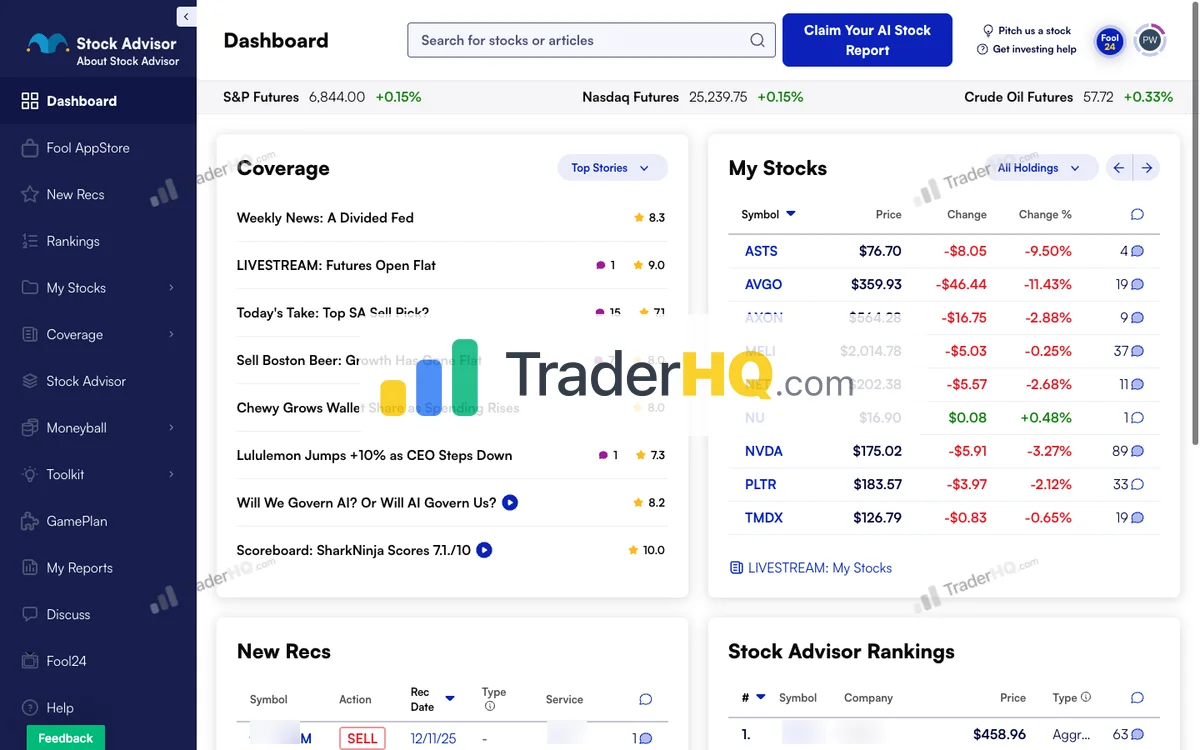
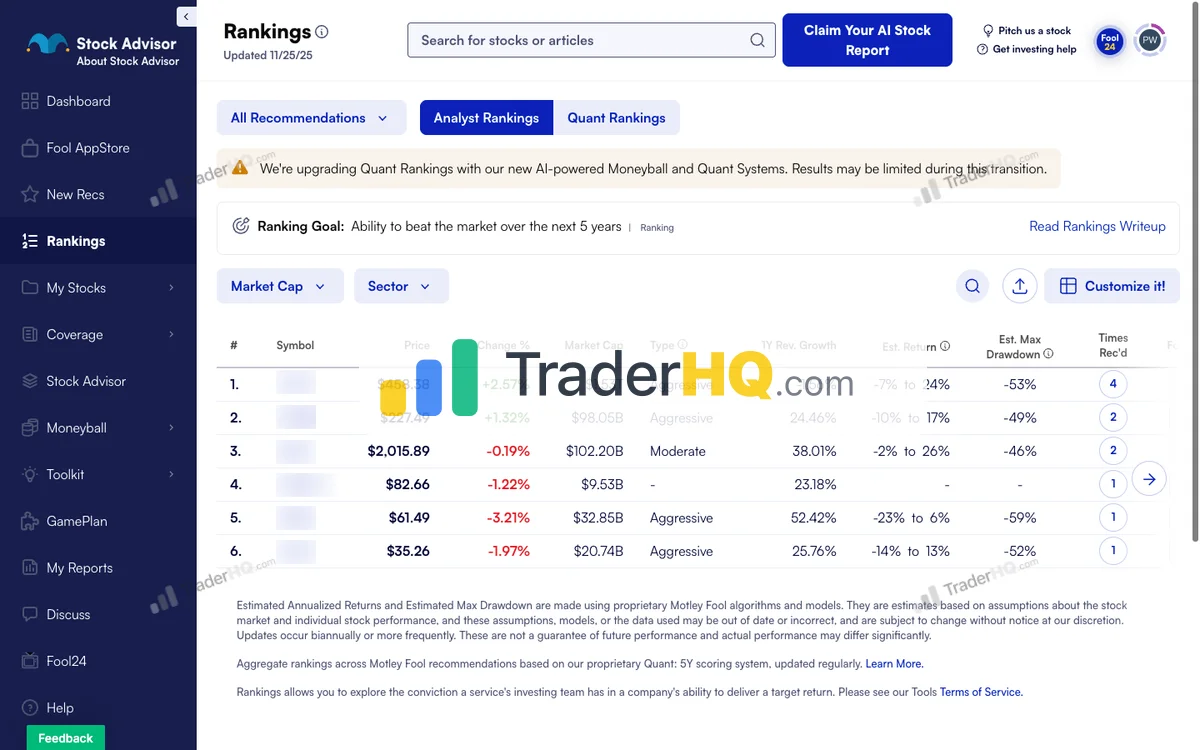
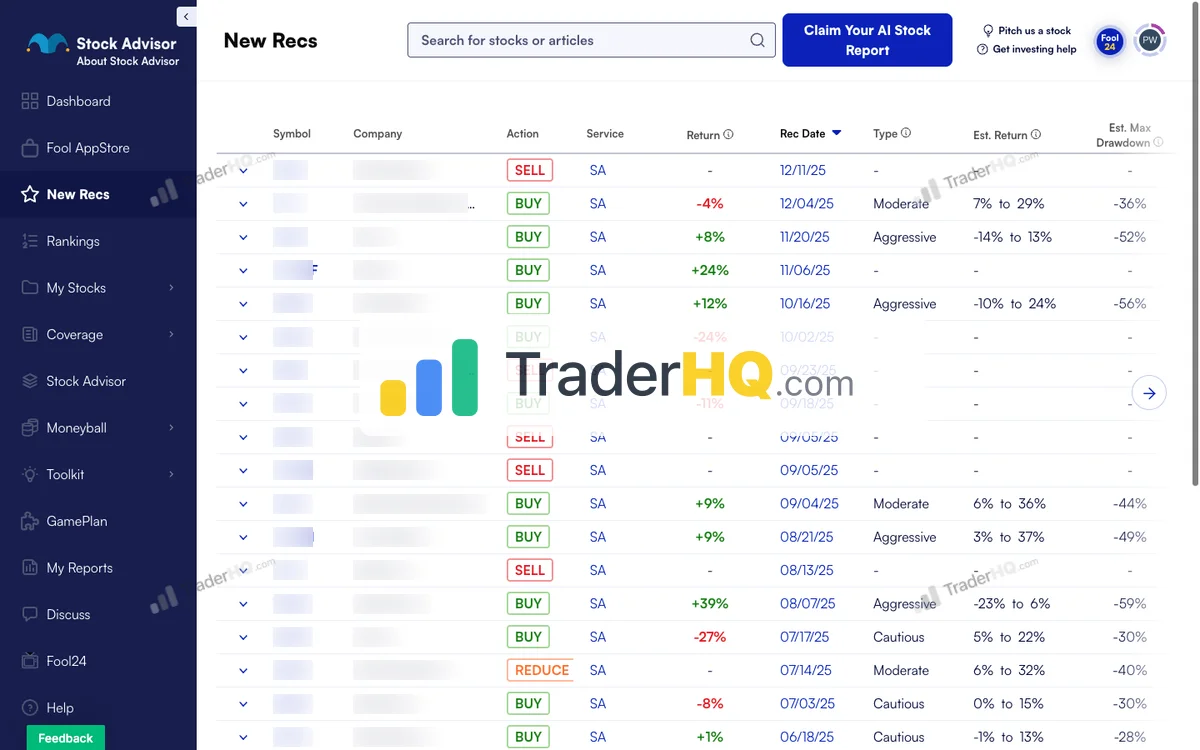
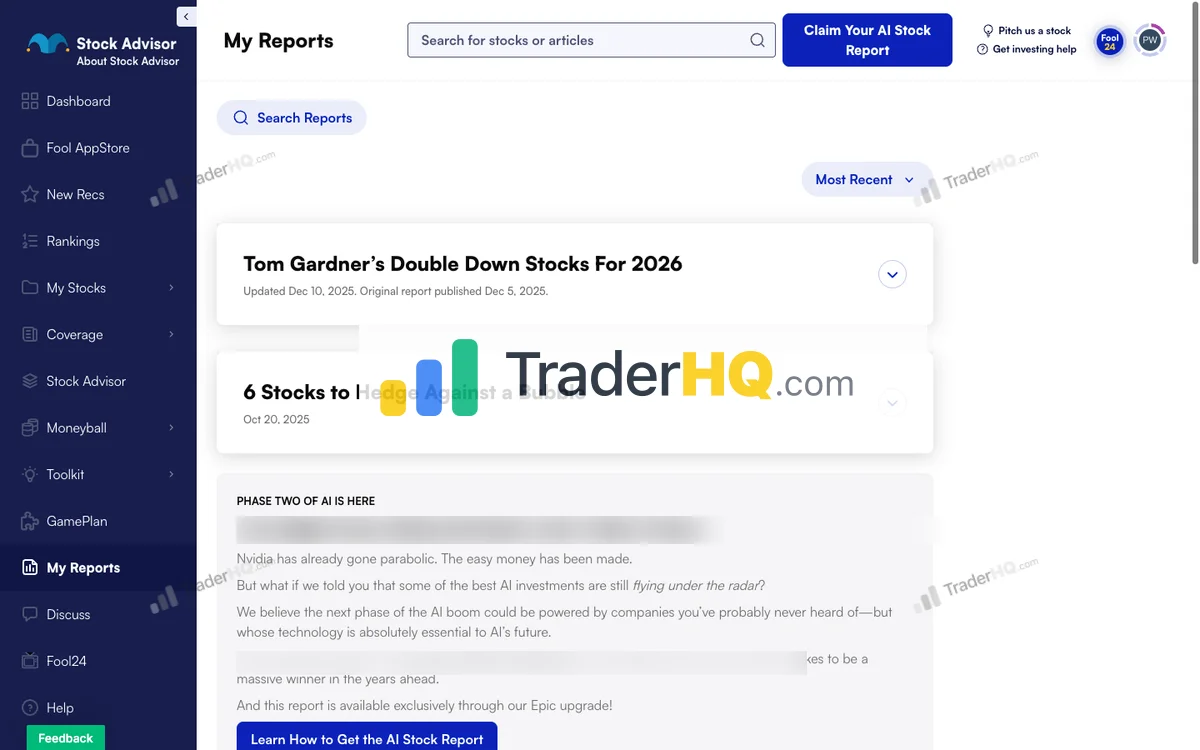
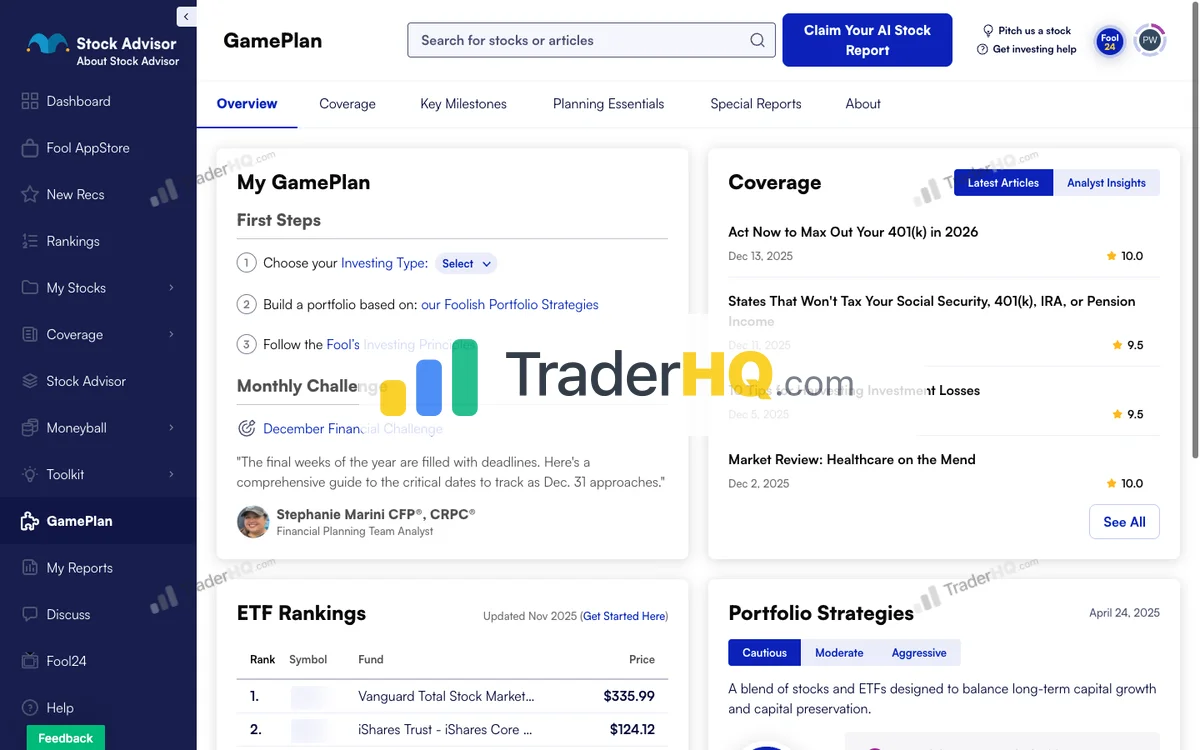
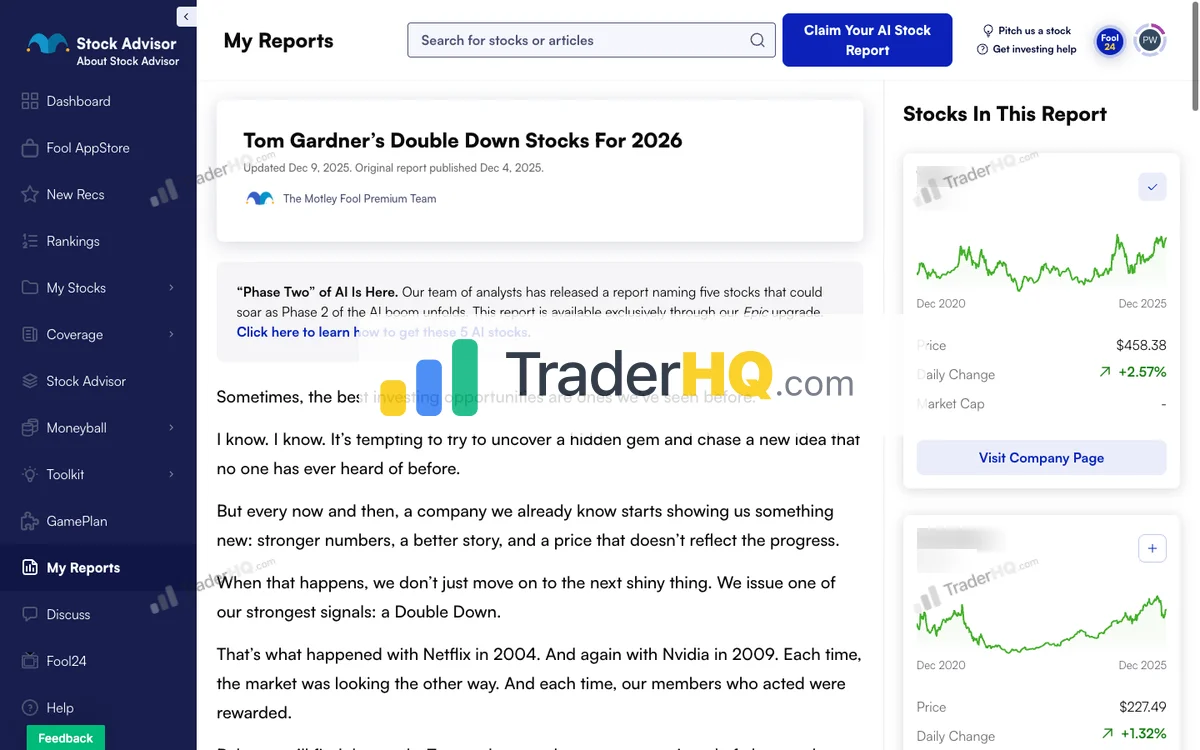
9 screenshots · Click to expand
Frequently Asked Questions
Motley Fool Stock Advisor vs Morningstar Investor: which is better?
Motley Fool Stock Advisor is better for most investors. It provides actionable stock picks backed by a 24.5-year track record with +978.9% total returns across 526 positions. Morningstar Investor is better for self-directed analysts who prefer professional research tools over stock recommendations. Motley Fool Stock Advisor gives you the picks; Morningstar Investor gives you the tools to find your own.
Is Motley Fool Stock Advisor worth it?
Yes, for long-term investors who can hold through volatility. At $99/year (promotional), Motley Fool Stock Advisor has delivered +978.9% returns since 2002 compared to +214% for its per-position S&P 500 benchmark. The service provides 2 stock picks per month, portfolio strategy frameworks, and a Moneyball database with 344 stocks. The catch: 34% of picks lose money, and the methodology requires a minimum 5-year holding period. The 30-day money-back guarantee lets you evaluate the service with zero risk.
Is Morningstar Investor worth it?
Yes, for investors who want research tools rather than stock picks. At $199/year (promotional) or $249/year, Morningstar Investor provides Fair Value estimates, Economic Moat ratings, stock and fund screeners with 200+ data points, and the Portfolio X-Ray tool. It is not a stock-picking service — there are no specific buy recommendations. The value depends entirely on your willingness to invest time in learning and using the platform. The 7-day free trial lets you test it before committing.
Can I use both Motley Fool Stock Advisor and Morningstar Investor?
Yes, and they complement each other well. Motley Fool Stock Advisor provides the stock picks and portfolio conviction. Morningstar Investor provides the research infrastructure to independently validate those picks — checking Fair Value estimates, assessing Economic Moats, and analyzing how recommendations fit your existing portfolio. Together, they cost roughly $300-450/year, which is a reasonable investment for a serious portfolio.
Does Morningstar Investor give stock picks?
No. Morningstar Investor is a research platform, not a stock-picking service. It provides Fair Value estimates, Economic Moat ratings, analyst reports, and screening tools, but it does not make specific buy or sell recommendations. If you want stock picks from Morningstar, their separate newsletter products (Morningstar StockInvestor, Morningstar DividendInvestor) offer portfolio-based recommendations, but these are distinct from Morningstar Investor.
What’s the difference between Motley Fool Stock Advisor and Morningstar Investor?
The fundamental difference is picks vs. tools. Motley Fool Stock Advisor is a stock-picking service that recommends 2 stocks per month, provides portfolio strategies, and tracks all recommendations on a public scorecard (+978.9% since 2002). Morningstar Investor is a research platform that gives you Fair Value estimates, Economic Moat ratings, screeners, and portfolio analysis tools to make your own investment decisions. Motley Fool Stock Advisor costs $99-199/year; Morningstar Investor costs $199-249/year.