

You’ve narrowed it down to two proven stock-picking newsletters: Motley Fool Stock Advisor and Morningstar StockInvestor. Both have 24+ year track records. Both serve long-term investors. Both cost under $200/year. And you’ve probably been going back and forth for days trying to figure out which one actually deserves your money.
The timing of this decision adds weight. The S&P 500 sits at 7,686 — up 13.1% year-to-date on a total-return basis (Slickcharts, Aug 31, 2026) — with the VIX calm at 14.92. But the calm hides a 210-point spread: the average top-20 S&P stock is up +168.7% this year while the average bottom-20 is down -41.6%. The Fed holds at 3.50-3.75% with September hike odds near 60-65%, CPI is running at 3.4% YoY, and valuations sit at dot-com-era extremes (CAPE ~40-42). Both services excel at quality investing through stretched valuations — but Motley Fool Stock Advisor picks the stocks for you while Morningstar StockInvestor gives you the analytical framework to evaluate them yourself.
Here’s the straight answer: Motley Fool Stock Advisor is the better choice for most investors. Its TraderHQ-computed +978.9% total return since 2002 and fully transparent scorecard give you something Morningstar StockInvestor doesn’t — proof you can audit. But Morningstar StockInvestor wins if you want a defensive, value-first approach backed by nearly $1 million of Morningstar’s own capital. Let me show you exactly why.
Motley Fool Stock Advisor vs Morningstar StockInvestor: Side-by-Side
| Dimension | Motley Fool Stock Advisor | Morningstar StockInvestor | Edge |
|---|---|---|---|
| Track Record | +978.9% since 2002 (TraderHQ-computed) | 25 years since 2001 (returns undisclosed) | Stock Advisor |
| Price | $199/yr (promo $99/yr) | ~$170/yr | StockInvestor |
| Picks Per Month | 2 new recommendations | Portfolio updates + trade alerts | Stock Advisor (more actionable) |
| Methodology | Growth/GARP, analyst-led | Wide-moat value, DCF fair value | Tie (different philosophies) |
| Volatility | High (30-50% drawdowns) | Lower (value/quality focus) | StockInvestor |
| Transparency | Full scorecard, every pick since 2002 | Real-money portfolios, exact positions | Tie (different kinds) |
| Skin in the Game | Analyst disclosures | ~$945K of Morningstar’s own capital | StockInvestor |
| Overall Winner | — | — | Stock Advisor (for most investors) |
Motley Fool Stock Advisor: The 24-Year Growth Engine
Motley Fool Stock Advisor is The Motley Fool’s flagship service, and it has earned that status through raw performance. The philosophy is straightforward: find companies with durable competitive advantages, buy them, and hold for years while compounding takes over.
The numbers tell the story. Since March 2002, Motley Fool Stock Advisor has delivered a +978.9% total return versus 214% for its per-position S&P 500 benchmark — TraderHQ analysis of the published trade log (data as of Aug 31, 2026). That’s not marketing spin — it’s computed across 526 picks with a publicly accessible scorecard. A $10,000 investment following their recommendations would be worth approximately $107,886 today. The same amount tracking the benchmark would be around $31,000.
But the headline return conceals the volatility you must endure. The 2021 vintage picks averaged -13% returns with a 32% win rate as growth stocks cratered. The Aggressive strategy warns of -59% max drawdowns on individual positions. Winners like NVIDIA (+133,425% since 2005) and Netflix (+43,971% since 2004) didn’t get there in a straight line — they endured stomach-churning drops along the way.
What makes Motley Fool Stock Advisor more than a tip sheet:
- Three portfolio strategies (Cautious, Moderate, Aggressive) calibrated to your risk tolerance, with explicit drawdown expectations
- Foundational Stocks list — 10 highest-conviction core holdings, updated regularly
- Moneyball database — 344 stocks scored across 12 dimensions for independent research
- Quantitative projections — estimated return ranges and max drawdown on every recommendation
The trade-off: The upsell pressure is relentless. Every article ends with a pitch for Epic Plus ($1,999/year). Subscriber comments frequently mention frustration with constant upgrade prompts. The base service is complete — but you’ll be regularly reminded it isn’t the “premium” version.
Best for: Investors with 5+ year horizons, $25,000+ portfolios, and the psychological resilience to hold through 30-50% drawdowns. The methodology rewards patience — positions held 5-10 years have a 62.9% win rate with average returns of 205.7%, while positions held 10+ years have a 92.2% win rate (TraderHQ analysis of the published trade log, data as of Aug 31, 2026).
Try Motley Fool Stock Advisor — 30-Day Guarantee
Morningstar StockInvestor: Institutional Moat Discipline
Morningstar StockInvestor takes a fundamentally different approach. Where Motley Fool Stock Advisor hunts for growth compounders, Morningstar StockInvestor buys wide-moat businesses when they trade below their intrinsic value. It’s the difference between betting on acceleration and betting on durability.
The core product is two real-money model portfolios:
The Tortoise Portfolio is value-oriented, holding approximately 31 positions worth ~$945,000 of Morningstar’s own capital. Managed by Michael Corty, CFA, it targets undervalued wide-moat companies with strong balance sheets. Current holdings include Berkshire Hathaway (9.4%), Philip Morris (6.3%), Meta Platforms (4.0%), and JPMorgan Chase (4.0%). Some positions date back to 2001.
The Hare Portfolio is growth-oriented within the moat framework, managed by Grady Burkett, CFA. It accepts more volatility in exchange for higher return potential while still requiring economic moats as a filter.
What makes Morningstar StockInvestor distinctive:
- Real money invested — Morningstar puts its own capital at risk, not just paper recommendations
- Proprietary ratings access — economic moat ratings, fair value estimates, and star ratings that typically require institutional subscriptions ($15,000+/year for Morningstar Direct)
- Complete position transparency — exact share counts, entry dates, and position sizes for every holding
- Named, credentialed analysts — CFA-holding portfolio managers with decades of Morningstar experience
The trade-off: Morningstar StockInvestor does not publicly disclose portfolio performance returns. You can see every position and calculate returns yourself, but the service doesn’t publish a scorecard the way Motley Fool Stock Advisor does. Pricing also isn’t prominently listed — estimated at ~$170/year based on similar Morningstar newsletters. The refund policy requires contacting customer service rather than offering a clear money-back guarantee.
Best for: Value-oriented investors who trust Morningstar’s institutional methodology, want lower volatility than growth-focused services, and care more about the discipline of buying undervalued quality than chasing high-growth compounders.
Head-to-Head: The Differences That Actually Matter
Performance Verification vs Reputation
This is the single biggest differentiator. Motley Fool Stock Advisor gives you a complete scorecard of all 526 picks since 2002 — winners, losers, and everything in between. You can verify the +978.9% total return yourself (TraderHQ analysis of the published trade log, data as of Aug 31, 2026). You can see the 2021 vintage averaged -13%. You can see that 34% of picks lose money. That transparency builds trust precisely because it includes the failures.
Morningstar StockInvestor has institutional credibility and 25 years of history, but performance data stays behind closed doors. Morningstar’s reputation as a research powerhouse is well-earned, and the fact that they invest nearly $1 million of their own capital signals real conviction. But for an investor trying to evaluate whether the service beats the market, the absence of published returns is a meaningful gap.
Growth vs Value Philosophy
Motley Fool Stock Advisor fishes for multi-baggers. The methodology explicitly targets companies with transformational upside — accepting that some picks will lose 50%+ to catch the ones that return 500%+. With 46 ten-baggers and 191 doublers in 24.5 years, the asymmetry has worked. But it requires tolerating significant drawdowns: the average loser loses -44.5%.
Morningstar StockInvestor buys quality at a discount. The Tortoise Portfolio targets stocks trading below fair value (Price/Fair Value ratio below 1.0), with many current holdings at 0.63 to 0.77 P/FV. This approach limits upside compared to pure growth but provides a margin of safety. At current valuations (CAPE ~40-42, the highest since 2000, with the S&P 500 up 13.1% year-to-date at 7,686), this discipline has particular relevance.
Actionability and Frequency
Motley Fool Stock Advisor delivers two new stock picks per month on a predictable schedule (2nd and 4th Thursdays), plus monthly Top 10 Rankings. The system is designed for portfolio building: start with Foundational Stocks, add new picks over time, and use the portfolio strategy frameworks for allocation guidance.
Morningstar StockInvestor operates more like a managed portfolio you follow. Monthly newsletters cover portfolio changes, trade alerts notify you of buys and sells in real-time, and weekly email updates keep you informed between issues. It’s less frequent but more reflective of how institutional managers operate.
Current Market Fit
With the CAPE ratio at ~40-42 and 210-point dispersion between winners and losers in 2026 — the top 20 holdings averaging +168.7% while the bottom 20 sit at -41.6% (Slickcharts, Aug 31, 2026) — stock selection is the entire game. Motley Fool Stock Advisor’s quality GARP methodology thrives in exactly this kind of bifurcated market. The rotation tells the story: Energy +38.4%, Technology +24.1%, and Basic Materials +20.4% are leading, but Tech is violently split internally — memory and storage names like SanDisk (+560%) and Micron (+236%) are soaring while ad-tech (Trade Desk -63.9%) and enterprise software (Intuit -45.8%) crater. Picking the right stocks within the right sectors is the difference between compounding and capital destruction.
Morningstar StockInvestor’s fair value discipline provides protection when valuations are this stretched. With the S&P 500 up 13.1% year-to-date at 7,686, the VIX calm at 14.92, and AAII bearishness at 44.4%, the wide-moat value framework that anchors StockInvestor’s Tortoise Portfolio offers genuine defensive positioning. CPI at 3.4% YoY with core at 2.5% keeps the Fed anchored at 3.50-3.75% — but with September hike odds near 60-65% after Jackson Hole, the hike decision is now the regime variable that matters, one that rewards patient, quality-focused approaches from both services. Credit spreads at 2.60% confirm no systemic stress, but the calm index surface masks enormous dispersion underneath. Past performance does not guarantee future results, but both approaches have been stress-tested through multiple market cycles.
How to Decide
Choose Motley Fool Stock Advisor if:
- You want auditable, transparent performance data you can check yourself
- You can hold through 30-50% drawdowns without panic selling
- You have a 5+ year horizon and want exposure to high-growth compounders
- You value a structured portfolio-building framework with actionable monthly picks
- You prefer explicit guidance: “buy this stock, here’s exactly why, here’s the expected volatility”
Choose Morningstar StockInvestor if:
- You trust Morningstar’s institutional research methodology and want to follow it
- You prefer a value-oriented approach that buys quality businesses below fair value
- You want lower volatility and are willing to accept potentially lower returns for it
- You care about the service investing its own real money (~$945K) alongside you
- You want access to Morningstar’s proprietary moat ratings, fair value estimates, and capital allocation scores
Consider using both if:
- You have enough capital to build positions across growth and value philosophies
- You want growth exposure (Motley Fool Stock Advisor) plus defensive quality (Morningstar StockInvestor)
- You believe diversification across investment styles matters as much as diversification across stocks
The tiebreaker: Ask yourself this: “If I could only see one number, would I rather see auditable returns (+978.9%) or the dollar amount Morningstar has invested alongside me (~$945K)?” If auditable returns matter more, choose Motley Fool Stock Advisor. If skin in the game matters more, choose Morningstar StockInvestor.
The Bottom Line
Motley Fool Stock Advisor wins for most investors. The +978.9% return over 24.5 years (TraderHQ analysis of the published trade log, data as of Aug 31, 2026), the transparent scorecard, the 46 ten-baggers, and the complete portfolio-building framework provide something no competitor in this comparison offers — auditable proof that the methodology works across every market cycle since 2002. At $199/year (or $99 with the new member promotion), the math works if you follow the strategy.
Morningstar StockInvestor is the smarter choice if you’re a value investor who wants institutional-quality moat analysis, lower volatility, and the confidence that comes from Morningstar investing nearly $1 million of its own capital in the recommendations. The methodology is sound, the credentials are impeccable, and the moat framework is particularly valuable when market valuations are stretched. The lack of published performance data is a real limitation, but for investors who trust the process over the scorecard, it’s a compelling service.
The real question is which philosophy matches your temperament. A brilliant service you can’t follow through drawdowns is worse than a good service you can stick with for a decade. Motley Fool Stock Advisor demands volatility tolerance. Morningstar StockInvestor demands patience for value to materialize. Both reward discipline.
Want to compare Morningstar’s research platform instead of their newsletter? See our Stock Advisor vs Morningstar Investor analysis. Considering other Stock Advisor alternatives? Check Stock Advisor vs Alpha Picks or Stock Advisor vs Rule Breakers.
If you’re starting from zero and can only pick one? Motley Fool Stock Advisor, because the transparent track record makes it easier to build conviction when the strategy is being tested.

Motley Fool Stock Advisor Performance
The Motley Fool · 526 picks · 25 years · Updated Aug 31, 2026
| SA Return | S&P 500 | Alpha | Win Rate |
|---|---|---|---|
| +979% | +214% | +765% | 66% |
S&P 500 shows what you'd have earned buying the index on each pick date instead. Same timing, fair comparison.
| SA Multi-Baggers | 10x+ | 5x+ | 3x+ | 2x+ |
|---|---|---|---|---|
| Count | 46 | 91 | 128 | 191 |
| SA Asymmetry | Avg Winner | Avg Loser | Ratio |
|---|---|---|---|
| Return | +1.7K% | -44% | ~38:1 |
Best Performers (All-Time)
| SA Pick | Return |
|---|---|
 NFLX Netflix | +44K% |
 CTAS CTAS | +4.6K% |
 BKNG Booking Holdings | +22K% |
 AAPL Apple | +6.5K% |
 AMZN Amazon | +35K% |
 DIS Disney | +6.1K% |
 TSLA Tesla | +16K% |
 MME.DL MME.DL | +4.3K% |
 NVDA NVIDIA | +133K% |
 SHOP Shopify | +4.6K% |
The multi-bagger pipeline. 191 doublers → 91 5-baggers → 46 10-baggers. About 24% of doublers become 10-baggers with enough time.
See All Stock Advisor Recommendations →Latest Stock Advisor Picks
Tickers masked to protect subscriber value. Recent picks need 3-5+ years to demonstrate thesis.
| SA Pick | Return |
|---|---|
**** Cloud Monitoring | +97% |
**** Chip Manufacturer | +85% |
**** Infrastructure Construction | +63% |
**** Growth Company | +51% |
**** Growth Company | +41% |
**** E-commerce & Cloud Giant | +28% |
**** Growth Company | +23% |
**** Convenience Stores | +19% |
**** Growth Company | +18% |
**** Growth Company | +16% |
Early results mislead. < 1 year: 57.1% win rate. 10+ years: 92.2%. That 35-point gap explains why judging picks early leads to selling future winners.
Stock Advisor Win Rate by Holding Period
| Hold Time | SA Win Rate | Avg Return |
|---|---|---|
| < 1 Year | 57.1% | +16% |
| 1-3 Years | 55.7% | +11% |
| 3-5 Years | 48.8% | +23% |
| 5-10 Years | 62.9% | +206% |
| 10+ Years | 92.2% | +4.1K% |
Time is the strategy. 10+ year picks show 92.2% win rate with +4.1K% average returns. Same methodology, same picks—time transforms the results.
Stock Advisor Performance by Year
| Year | SA Picks | Avg Return | Win Rate | |
|---|---|---|---|---|
| 2026 | 31 | +10% | 57% | DDOG+97% |
| 2025 | 26 | +7% | 48% | ASML+133% |
| 2024 | 25 | +25% | 67% | AMD+186% |
| 2023 | 25 | +78% | 73% | CRWD+607% |
| 2022 | 23 | +58% | 59% | NET+495% |
| 2021 | 22 | -13% | 32% | LRCX+491% |
| 2020 | 24 | +146% | 46% | TSLA+1.1K% |
| 2019 | 23 | +56% | 70% | SNPS+259% |
| 2018 | 19 | +228% | 68% | SHOP+1.1K% |
| 2017 | 22 | +700% | 86% | NVDA+8.4K% |
| 2016 | 20 | +446% | 80% | SHOP+4.6K% |
| 2015 | 22 | +208% | 68% | CASY+839% |
| 2014 | 20 | +354% | 80% | ATVI+2.8K% |
| 2013 | 17 | +386% | 65% | NFLX+2.5K% |
| 2012 | 23 | +1.2K% | 74% | TSLA+16K% |
| 2011 | 19 | +561% | 63% | AAPL+3.2K% |
| 2010 | 18 | +459% | 83% | AMZN+2.9K% |
| 2009 | 20 | +3.3K% | 90% | NVDA+56K% |
| 2008 | 18 | +1.2K% | 89% | AAPL+6.5K% |
| 2007 | 19 | +1.5K% | 37% | NFLX+29K% |
| 2006 | 20 | +2.5K% | 65% | NFLX+25K% |
| 2005 | 16 | +8.4K% | 63% | NVDA+133K% |
| 2004 | 17 | +6.0K% | 59% | NFLX+44K% |
| 2003 | 17 | +229% | 65% | PHIN+1.4K% |
| 2002 | 16 | +3.2K% | 81% | AMZN+35K% |
Inside Stock Advisor
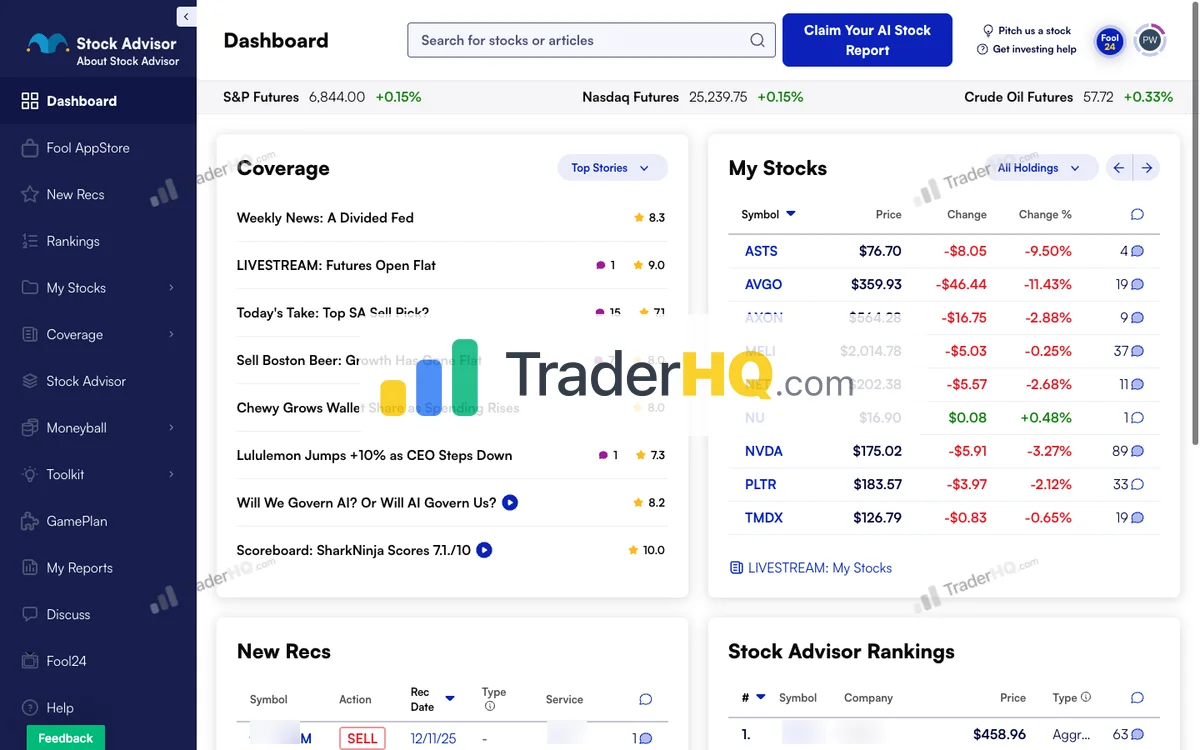
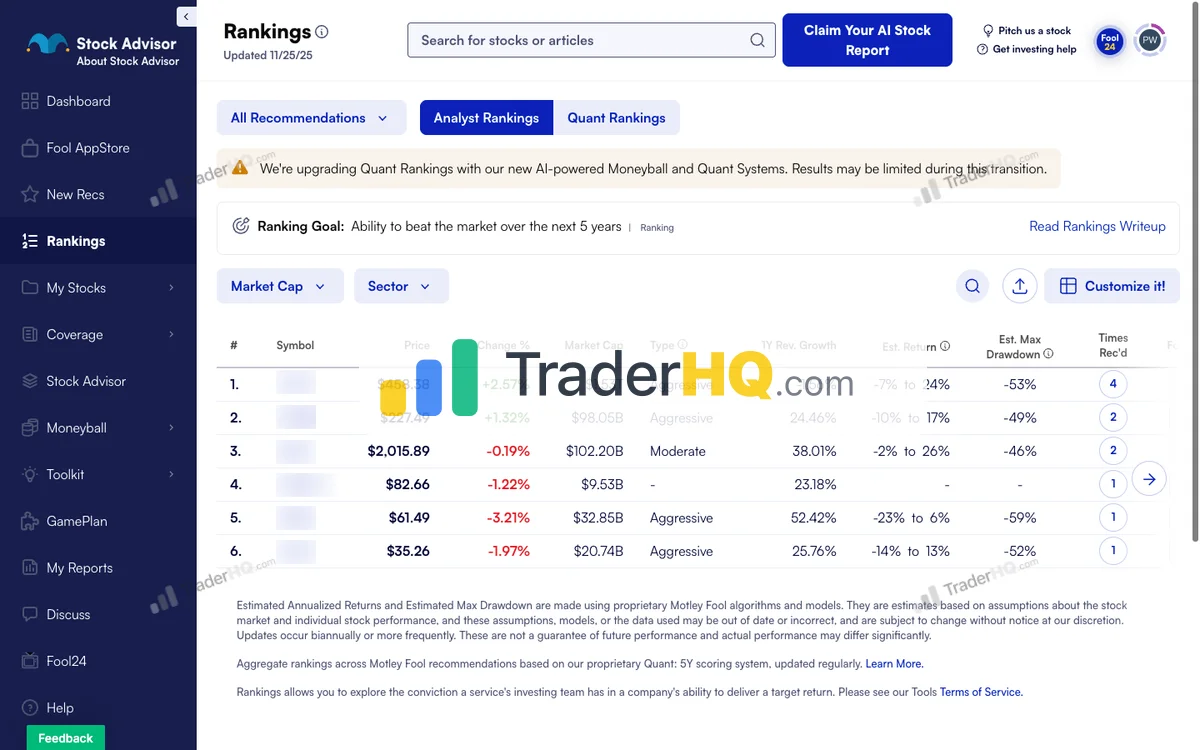
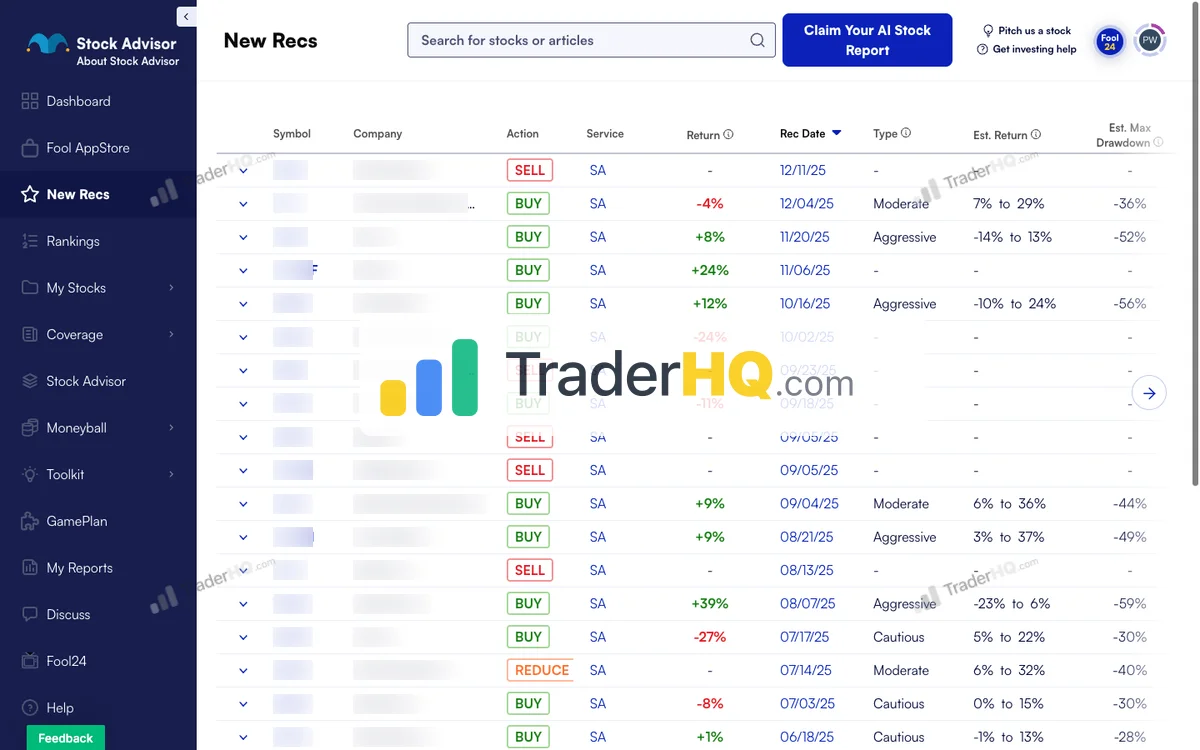
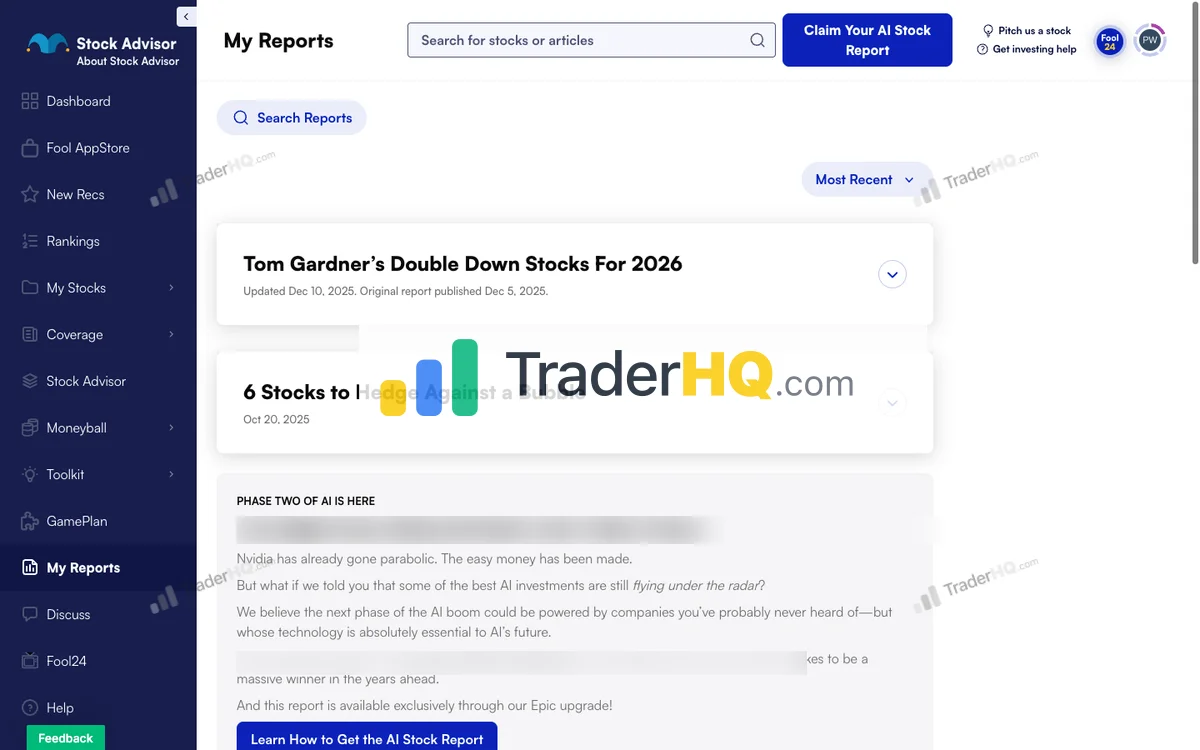
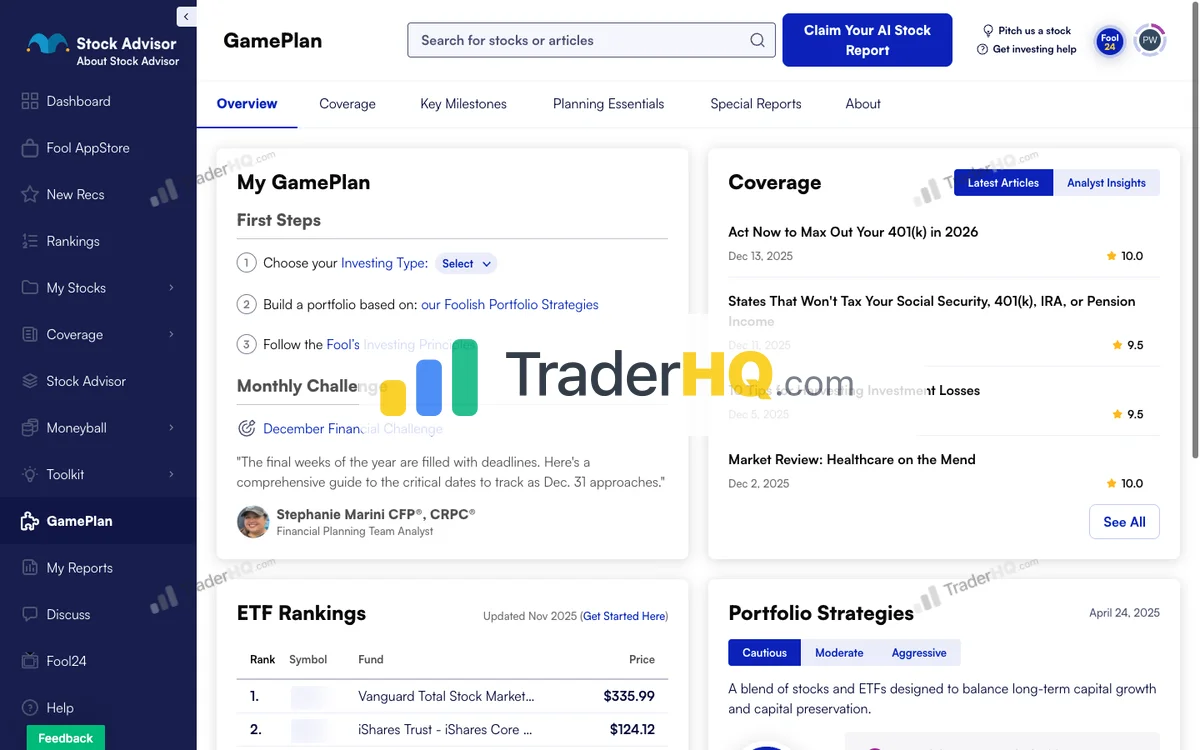
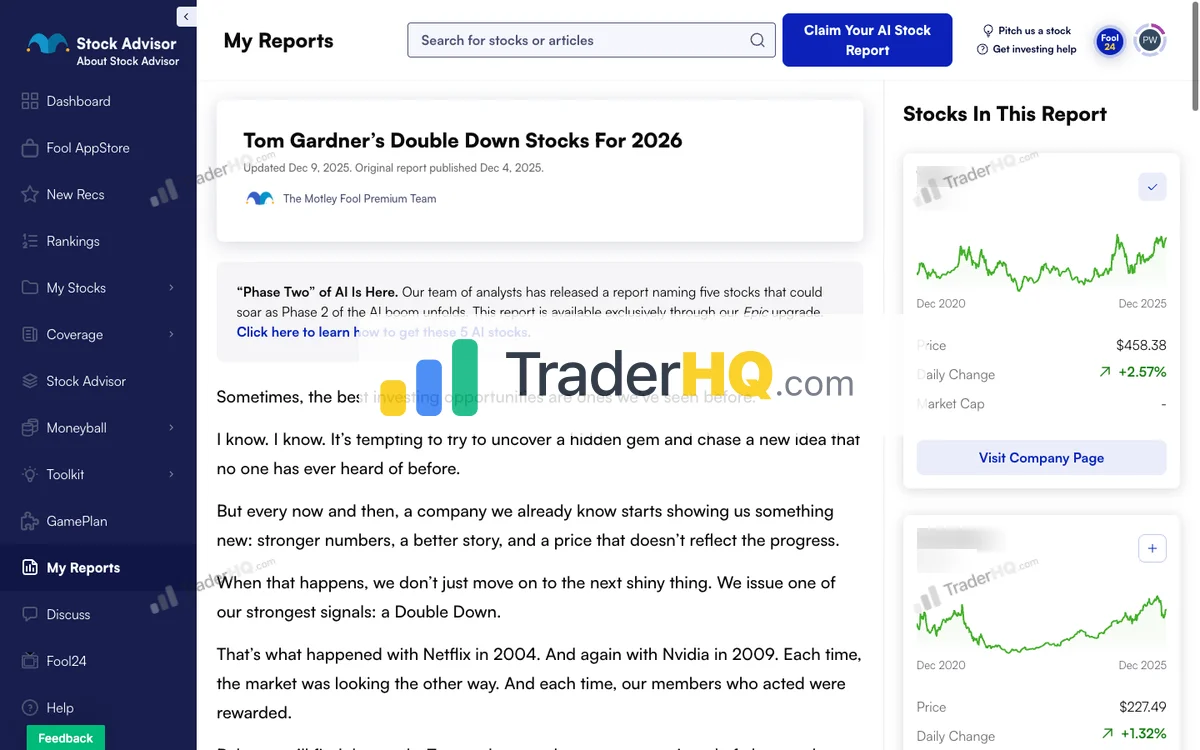
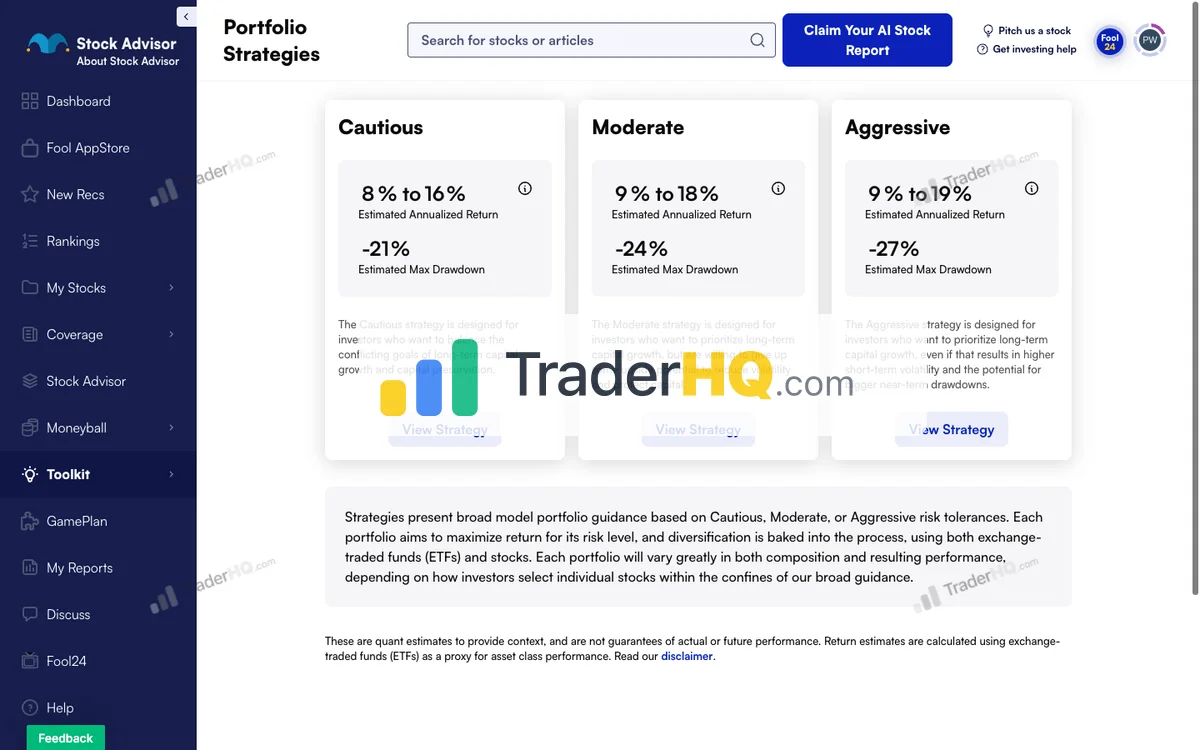
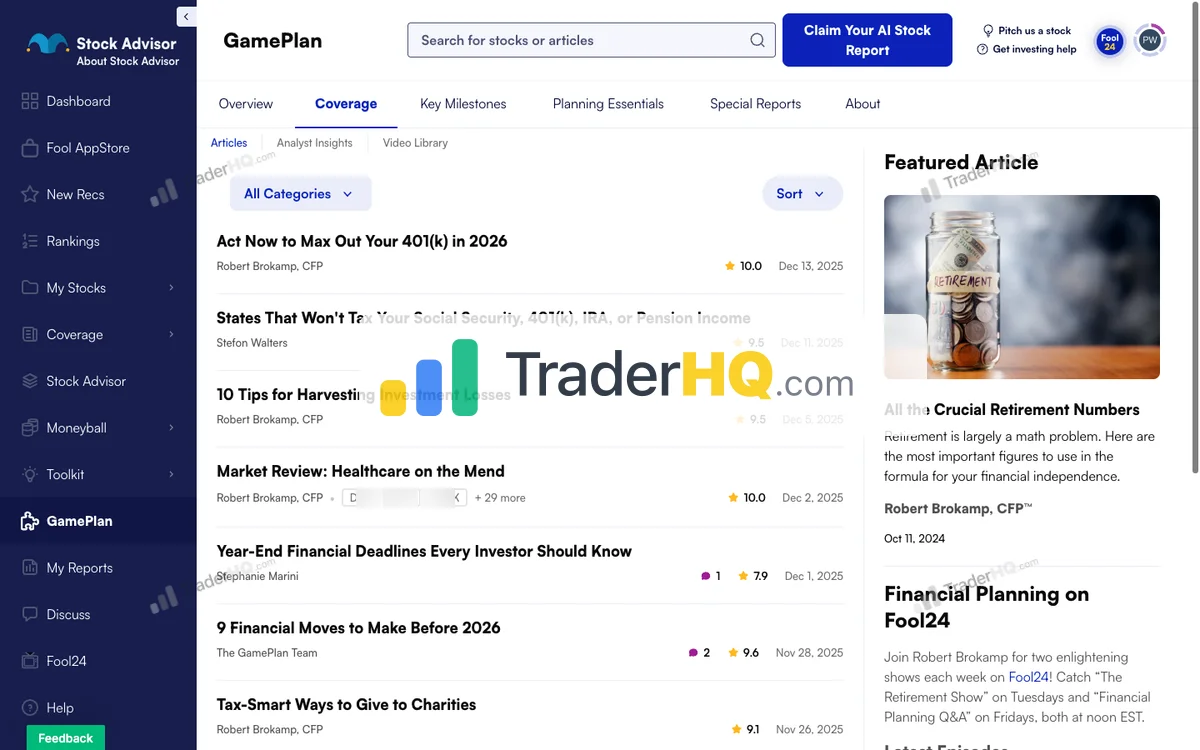
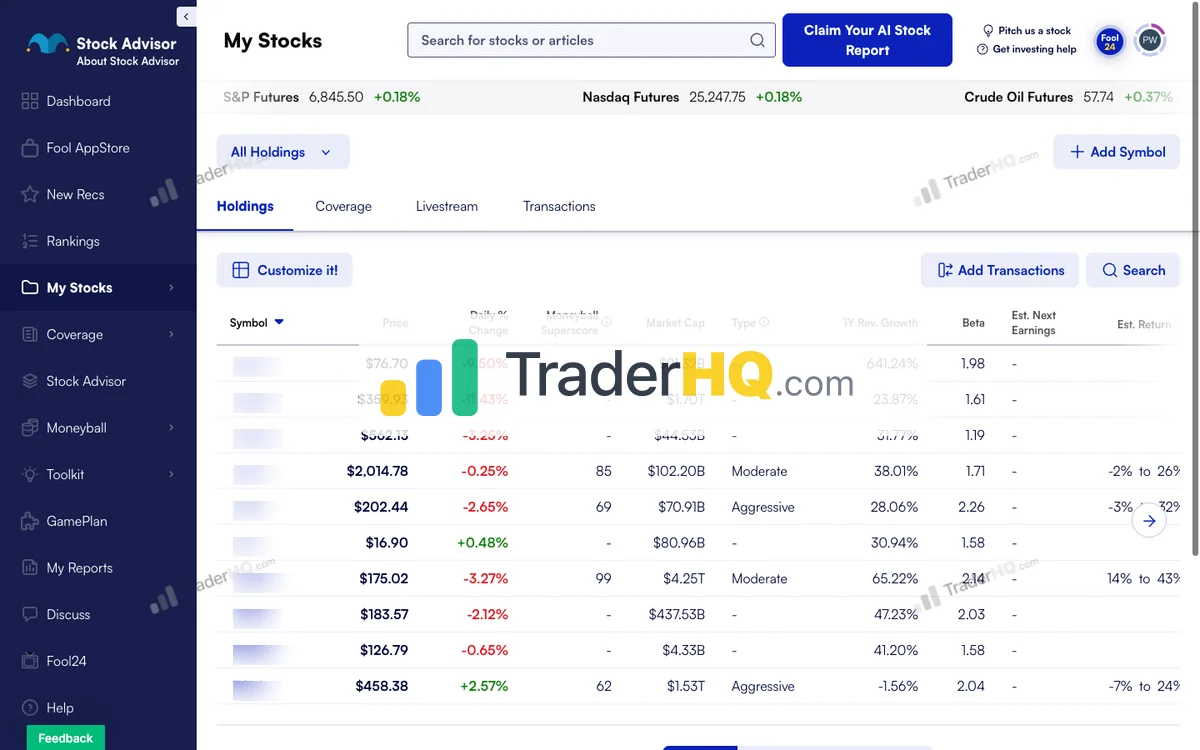
9 screenshots · Click to expand
Frequently Asked Questions
Motley Fool Stock Advisor vs Morningstar StockInvestor: which is better?
Motley Fool Stock Advisor is the better choice for most investors. It has delivered a +978.9% total return since 2002 (versus 214% for its per-position S&P 500 benchmark; TraderHQ analysis of the published trade log, data as of Aug 31, 2026), publishes a complete scorecard of all 526 picks, and provides a structured portfolio-building framework. Morningstar StockInvestor offers a strong value-oriented alternative with real-money portfolios and institutional-quality moat analysis, but does not publicly disclose performance returns. For investors who prioritize verifiable track records and growth potential, Motley Fool Stock Advisor wins. For value investors who trust Morningstar’s methodology and want lower volatility, Morningstar StockInvestor is compelling.
Is Motley Fool Stock Advisor worth it?
Yes, for long-term investors who can hold 5+ years. At $199/year ($99 promotional rate), Motley Fool Stock Advisor has returned +978.9% since 2002 across 526 picks with a 66% win rate (TraderHQ analysis of the published trade log, data as of Aug 31, 2026). The service includes two monthly stock picks, a Foundational Stocks list, portfolio strategy frameworks, and access to the Moneyball research database. The main drawbacks are significant volatility (expect 30-50% drawdowns) and persistent upsell pressure to higher-tier services. Past performance does not guarantee future results, but the 24.5-year track record through multiple bear markets demonstrates the methodology’s durability.
Is Morningstar StockInvestor worth it?
Yes, for value-oriented investors who trust Morningstar’s moat framework. At approximately $170/year, Morningstar StockInvestor provides access to two real-money model portfolios (Tortoise and Hare) managed with Morningstar’s proprietary economic moat methodology. The Tortoise portfolio holds ~$945,000 of Morningstar’s own capital with positions dating back to 2001. You get access to moat ratings, fair value estimates, and capital allocation scores that typically require institutional subscriptions. The main limitation is that performance returns are not publicly disclosed, making it harder to evaluate results compared to competitors.
Can I use both Motley Fool Stock Advisor and Morningstar StockInvestor?
Yes, and it’s a strong combination. Motley Fool Stock Advisor focuses on growth/GARP investing while Morningstar StockInvestor focuses on undervalued wide-moat businesses. The overlap between their portfolios is minimal because they fish in different waters. Using both gives you growth exposure from Motley Fool Stock Advisor’s high-conviction picks and defensive value positioning from Morningstar StockInvestor’s moat-based portfolios. The combined cost (~$370/year) is reasonable for investors with portfolios large enough to act on recommendations from both services.
How do Motley Fool Stock Advisor and Morningstar StockInvestor differ in their investing approach?
They represent opposite ends of the long-term investing spectrum. Motley Fool Stock Advisor uses a growth/GARP approach, targeting companies with transformational upside and recommending 5+ year holding periods. The methodology accepts high volatility (30-50% drawdowns) in exchange for multi-bagger potential — 46 picks have returned 10x or more. Morningstar StockInvestor uses a wide-moat value approach, buying quality companies only when they trade below Morningstar’s calculated fair value. The Tortoise portfolio is defensive and lower-volatility, while the Hare portfolio accepts more growth exposure within the moat framework. Both require patience, but Motley Fool Stock Advisor demands tolerance for volatility while Morningstar StockInvestor demands patience for value to materialize.
Which service is better in the current market environment?
Both services are well-positioned in 2026, but for different reasons. With the CAPE ratio at approximately 40-42 — the highest since 2000 — 210-point dispersion between winners and losers (the top 20 S&P stocks average +168.7% while the bottom 20 sit at -41.6%, per Slickcharts), the VIX at a calm 14.92, and AAII bears at 44.4%, the market rewards both stock selection and valuation discipline. Motley Fool Stock Advisor thrives in high-dispersion markets because its conviction-based methodology identifies winners from losers — memory and storage names (SanDisk +560%, Micron +236%) lead while ad-tech (Trade Desk -63.9%) and enterprise software (Intuit -45.8%) lag. Morningstar StockInvestor’s fair value discipline provides protection when valuations are stretched and sector rotation is violent — Energy +38.4% leads while Consumer Cyclical lags at -3.5%. With the Fed holding at 3.50-3.75%, CPI at 3.4% YoY, and September hike odds near 60-65%, the macro backdrop favors quality approaches from both services. Past performance does not guarantee future results in either case.