

The Best Stock Advisor Service Overall: Motley Fool Stock Advisor — 24.5 years. Official Fool.com scorecard: +981% vs S&P +216% as of August 14, 2026. Live book: 286 actives, 66% win rate, 49 ten-baggers, 173 doublers. Last independent audit (February 18): +888.4% across 504 positions, 65% win, 42 ten-baggers — labeled, and stale until the next scrape. The longest-running, most transparent stock advisor available. Read our full Stock Advisor review.
February’s argument was “the index is flat, so you have to pick.” That argument is finished — and advisors still earn their keep. The S&P 500 is up +14.54% YTD (Slickcharts, August 14) around ~7,600. Index investors got paid. The reason a stock advisor is not optional is the 211-point gap underneath that headline. The average top-20 S&P name is up +170.4%. The average bottom-20 is down −40.5%. SanDisk is +591%. The Trade Desk is −63%. Same index. Opposite lives.
The year split in two: Hardware Boom, Software Wipeout. Memory and servers printed multi-bagger YTD returns — SNDK +591%, DELL +290%, STX +253%, MU +240%, WDC +195%. Software, ads, and several consumer brands were wrecked — TTD −63%, APP −53%, INTU −48%, LULU −42%, NKE −36%, CRM −26%, ADBE −25%. Energy is still a sector leader at roughly +38% YTD. This is not “tech vs not-tech.” It is picks-and-shovels versus the software story.
The macro tape is not February’s either. Headline CPI is 3.4% (BLS, July) — up from February’s 2.4%. The easy disinflation lap is over. The 10-year yield is 4.68%. The 2-year is 4.17%, now above the fed-funds range. A divided Fed held at 3.50–3.75% on July 28–29 (9–3, hike dissenters). Next meeting: September 15–16. VIX is a calm ~14. CAPE sits near 41–42. AAII bears (37.9%) still outnumber bulls (34.7%) after a 15% rally — the crowd is not celebrating.
Run the numbers on what compressed forward returns actually cost you:
- $100K at 7% for 10 years = ~$197K (passive indexing at CAPE ~41–42)
- $100K at 11% for 10 years = ~$289K (with quality stock advisor alpha)
- The gap: $92,000 from a single portfolio
That $92K difference is the price of settling for index returns when valuations are at their second-highest level in 155 years. The index got its year. The extra two to four points of annual alpha still live in the 211-point tails — not in buying SPY and waiting.
The real economy is expanding while the index is expensive. ISM Manufacturing printed 55.6 in July — strongest since May 2022. Services PMI is 54.1. Credit spreads are a calm 2.71%. That combination — a manufacturing revival, an expensive index, and a stock-level civil war — is why a quality stock advisor is the wealth-building lever, not a luxury. Explore Motley Fool Stock Advisor’s Track Record.
Rank by the horizon you can actually hold, not by the loudest marketing page:
- 5–10 year conviction: Stock Advisor first — official +981% vs +216%, 66% win, 49 ten-baggers, 92.9% win rate once a pick has been held 10+ years
- 1–3 year quant: Alpha Picks — live +378.5% vs +105.6%, 103 positions, 70% win, 4 ten-baggers. APP is both the trophy (+1,571% from the 2023 rec) and the warning (−53% YTD)
- Disruptors you can hold: Rule Breakers — official +318% vs +187%, 219 positions, 75% win, 37 ten-baggers, TSLA +16,224%. Hardware is their habitat. Software drawdowns are only an entry if you can sit a decade
At CAPE ~41–42, expected 5- and 10-year index returns compress to the mid-single digits. A 211-point winner-loser gap is where the extra 2–4 points of annual alpha actually live.
Why Stock Picking Matters More in 2026
The Forward Return Problem
After +25% in 2024 and +17.9% in 2025, 2026 added another +14.54% by mid-August (Slickcharts). Three strong years in a row did not make the index cheap. CAPE at ~41–42 is still the second-highest reading in 155 years. Only the dot-com peak was higher. The index is no longer stuck. The names inside it are at war.
What does that mean for your portfolio? Forward return estimates tell the story:
- Expected 1-year S&P 500 return: 0-18% (hike scare vs hardware extension)
- Expected 3-year CAGR: 4-8%
- Expected 5-year CAGR: 5-8%
- Expected 10-year CAGR: 6-8%
- Historical average: 10.2%
When the index is expected to deliver 5-8% instead of 10%+, every extra percentage point of alpha carries outsized weight. Indexing at CAPE 42 is a fine default. It is not a wealth-maximizing plan for someone willing to do the work.
The Compounding Gap Is Real
Here’s what compressed index returns actually cost over a decade:
| Growth Rate | $100K After 10 Years | Difference vs. 11% |
|---|---|---|
| 7% (index estimate) | $197K | -$92K |
| 9% (optimistic index) | $237K | -$52K |
| 11% (with alpha) | $289K | Baseline |
| 14% (strong alpha) | $379K | +$90K |
A stock advisor that adds 2-4% annual alpha to a compressed-return index doesn’t just beat the market. It fundamentally changes your retirement math. That is the whole case for paying $99 — or $449 — if, and only if, you can hold the book.
The Dispersion Multiplier
Alpha only matters if it’s available to capture. Right now, it is — in abundance, and in a shape most “tech vs not-tech” commentaries still miss.
Dispersion is 211 points — top 20 average +170.4%, bottom 20 average −40.5% (Slickcharts, August 14). That is more than two and a half times February’s gap, and it arrived after the index already ran.
The INTRA-SECTOR split is the year. Hardware and memory printed multi-baggers. Software and ad-tech were wrecked. A service that cannot tell SanDisk from The Trade Desk is not doing its job — they carry the same sector label and produced a 650-point spread between them.
Fear is gone. The sorting is not. VIX is ~14. AAII bears still outnumber bulls at 37.9% vs 34.7%. Credit spreads at 2.71% and ISM Manufacturing at 55.6 say expansion, not a credit event. Headline CPI at 3.4% and a 9–3 FOMC say September is live. This is a market that’s sorting, not breaking — and sorting is the whole job of a stock advisor.
This isn’t a simple bull market. It’s a bifurcated market with structural fault lines and a skeptical crowd — and it rewards precision.
Why Stock Advisors Earn Their Keep Now
When the index has already been paid and the names inside it still range from +591% to −63%, advisors stop being a “nice to have”:
- Stock Advisor’s quality GARP focus is how you own hardware and memory without marrying wrecked software multiples — official +981% vs S&P +216%, 49 ten-baggers, 24.5 years through 2008/2020/2022. Rank it first if you can hold 5–10 years.
- Alpha Picks’ quant model is built for a 211-point tape — live +378.5% vs S&P +105.6%, 70% win, 103 positions. Rank it first for 1–3 year horizons. APP +1,571% from the 2023 rec and −53% YTD is the live sell-discipline test, not a footnote.
- Morningstar’s fair value discipline matters at CAPE ~41–42 with CPI 3.4% and a 10-year at 4.68% — knowing what’s actually cheap is the job. It is research, not a pick book.
- Rule Breakers’ innovation thesis is a split: official +318% vs +187%, 219 actives, 75% win, 37 ten-baggers. Hardware is the boom. Software drawdowns are the entry set if — and only if — you can hold a decade.
Bottom line: The S&P is up +14.54%. That used to be the end of the “you need a picker” argument. It isn’t, because SanDisk and The Trade Desk live in the same index. VIX ~14 is complacency. CPI 3.4% and a 9–3 Fed are the other half of the tape. Selection is still the whole game.
The Quick Answer: Best Stock Advisors Compared
| Rank | Service | Best For | Track Record | Price | 2026 Fit |
|---|---|---|---|---|---|
| 🥇 | Stock Advisor | Long-term growth (5+ years) | Official +981% vs S&P +216% (49 ten-baggers) | $99/yr | Exceptional — GARP on a 211-pt hardware/software split |
| 🥈 | Alpha Picks | Data-driven investors (1-3 years) | +378.5% vs S&P +105.6% (70% win, 103 positions) | $449/yr | Situational — 211-pt tape helps; APP −53% YTD is the live caution |
| 🥉 | Rule Breakers | Disruptors you can hold | +318% vs S&P +187% (37 ten-baggers, 219 positions) | $299/yr | Strong — hardware/memory is their habitat; software needs a holder |
| 4 | Morningstar Investor | DIY researchers | N/A (40+ year research platform) | $249/yr | Exceptional — fair value essential at CAPE ~41–42 |
| 5 | 7investing | Innovation enthusiasts | Not disclosed | $199/yr | Situational — deep research, unproven track |
| 6 | Zacks Premium | Earnings-focused | 37+ year methodology | $249/yr | Good — manufacturing expansion supports earnings |
| 7 | Danelfin | AI/quant enthusiasts | +263% since 2017 | $39/mo | Situational — AI scoring in high-dispersion market |
The Scenario Cheat Sheet:
- Just starting out (<$25K)? Stock Advisor — proven track record, complete framework, 30-day guarantee
- Building serious wealth ($50K+)? Stock Advisor + Alpha Picks — combine human conviction with quant validation
- Want to pick your own stocks? Morningstar Investor — research tools, not recommendations (40+ years of methodology)
- High risk tolerance? Rule Breakers — more volatility, more upside — if you can hold disruptors
- Trust algorithms over humans? Alpha Picks — pure quant, zero human discretion, 70% win rate, no refund
- Want deep research on fewer picks? 7investing — 1 pick/month with extensive thesis
- Prefer AI-driven analysis? Danelfin — explainable AI, 10,000+ features per stock
Time Horizon Matching:
- 1-3 years: Alpha Picks — 77.6% win rate in the 1–3 year bucket, +378.5% total return since 2022
- 5-10 years: Stock Advisor — 63.6% win rate and +207.6% average return in the 5–10 year bucket
- 10+ years: Stock Advisor — 92.9% win rate, 49 ten-baggers, 173 doublers
1. Motley Fool Stock Advisor

Patient growth investors who hold through volatility for 5+ years
We do not rank Motley Fool Stock Advisor first because it is the most famous name on this list. We rank it first because 2026 is a conviction market, and this is the only service whose entire design — two picks a month, a Best Buys Now list, a 5–10 year hold — is built to harvest a 211-point gap after the index has already been paid.
The objection this year is: “The S&P is up 14.54%. Why do I need an advisor?” Because SanDisk and The Trade Desk live in the same index. Because CAPE ~41–42 still compresses the next decade of passive returns into the mid-single digits. Because a 24.5-year GARP book with a 92.9% win rate on 10+ year holds is how you own the hardware winners long enough to matter and sit through — or skip — the software wreckage without a stop selling you out of a future compounder.
Motley Fool Stock Advisor Performance
The Motley Fool · 523 picks · 25 years · Updated Aug 14, 2026
| SA Return | S&P 500 | Alpha | Win Rate |
|---|---|---|---|
| +981% | +216% | +764% | 66% |
S&P 500 shows what you'd have earned buying the index on each pick date instead. Same timing, fair comparison.
| SA Multi-Baggers | 10x+ | 5x+ | 3x+ | 2x+ |
|---|---|---|---|---|
| Count | 49 | 90 | 127 | 193 |
| SA Asymmetry | Avg Winner | Avg Loser | Ratio |
|---|---|---|---|
| Return | +1.7K% | -45% | ~38:1 |
Best Performers (All-Time)
| SA Pick | Return |
|---|---|
 TSLA Tesla | +16K% |
 CTAS CTAS | +4.5K% |
 BKNG Booking Holdings | +23K% |
 DIS Disney | +6.0K% |
 SHOP Shopify | +4.7K% |
 MME.DL MME.DL | +4.3K% |
 AAPL Apple | +6.2K% |
 AMZN Amazon | +34K% |
 NVDA NVIDIA | +138K% |
 NFLX Netflix | +42K% |
49 ten-baggers. These 1,000%+ winners—NVDA, NFLX, AMZN—are what drive the portfolio. You don't need to pick all winners; you need a few massive ones.
See All Stock Advisor Recommendations →Latest Stock Advisor Picks
Tickers masked to protect subscriber value. Recent picks need 3-5+ years to demonstrate thesis.
| SA Pick | Return |
|---|---|
**** Chip Manufacturer | +112% |
**** Cloud Monitoring | +112% |
**** Infrastructure Construction | +100% |
**** Growth Company | +77% |
**** Growth Company | +50% |
**** Growth Company | +41% |
**** Convenience Stores | +33% |
**** Growth Company | +29% |
**** E-commerce & Cloud Giant | +26% |
**** Growth Company | +20% |
$10K → $108K. Following every recommendation since inception would yield a 10.8x return. Recent picks look small now, but compounding hasn't had time to work.
Stock Advisor Win Rate by Holding Period
| Hold Time | SA Win Rate | Avg Return |
|---|---|---|
| < 1 Year | 61.1% | +22% |
| 1-3 Years | 55.7% | +18% |
| 3-5 Years | 47.7% | +20% |
| 5-10 Years | 63.6% | +208% |
| 10+ Years | 92.9% | +4.1K% |
Time is the strategy. 10+ year picks show 92.9% win rate with +4.1K% average returns. Same methodology, same picks—time transforms the results.
Stock Advisor Performance by Year
| Year | SA Picks | Avg Return | Win Rate | |
|---|---|---|---|---|
| 2026 | 30 | +21% | 64% | INTC+112% |
| 2025 | 26 | +14% | 52% | ASML+154% |
| 2024 | 24 | +30% | 65% | AMD+216% |
| 2023 | 26 | +89% | 70% | CRWD+602% |
| 2022 | 23 | +58% | 59% | NET+527% |
| 2021 | 22 | -12% | 27% | LRCX+551% |
| 2020 | 23 | +133% | 43% | TSLA+1.1K% |
| 2019 | 23 | +54% | 70% | SNPS+242% |
| 2018 | 19 | +223% | 68% | SHOP+1.1K% |
| 2017 | 22 | +711% | 86% | NVDA+8.7K% |
| 2016 | 20 | +446% | 85% | SHOP+4.7K% |
| 2015 | 22 | +215% | 68% | CASY+952% |
| 2014 | 20 | +353% | 80% | ATVI+2.8K% |
| 2013 | 17 | +370% | 65% | NFLX+2.4K% |
| 2012 | 23 | +1.2K% | 74% | TSLA+16K% |
| 2011 | 19 | +585% | 63% | AAPL+3.1K% |
| 2010 | 18 | +459% | 83% | AMZN+2.9K% |
| 2009 | 20 | +3.3K% | 90% | NVDA+58K% |
| 2008 | 18 | +1.2K% | 94% | AAPL+6.2K% |
| 2007 | 19 | +1.5K% | 37% | NFLX+28K% |
| 2006 | 20 | +2.4K% | 65% | NFLX+24K% |
| 2005 | 16 | +8.7K% | 63% | NVDA+138K% |
| 2004 | 17 | +5.8K% | 59% | NFLX+42K% |
| 2003 | 17 | +239% | 65% | PHIN+1.5K% |
| 2002 | 16 | +3.1K% | 81% | AMZN+34K% |
Inside Stock Advisor
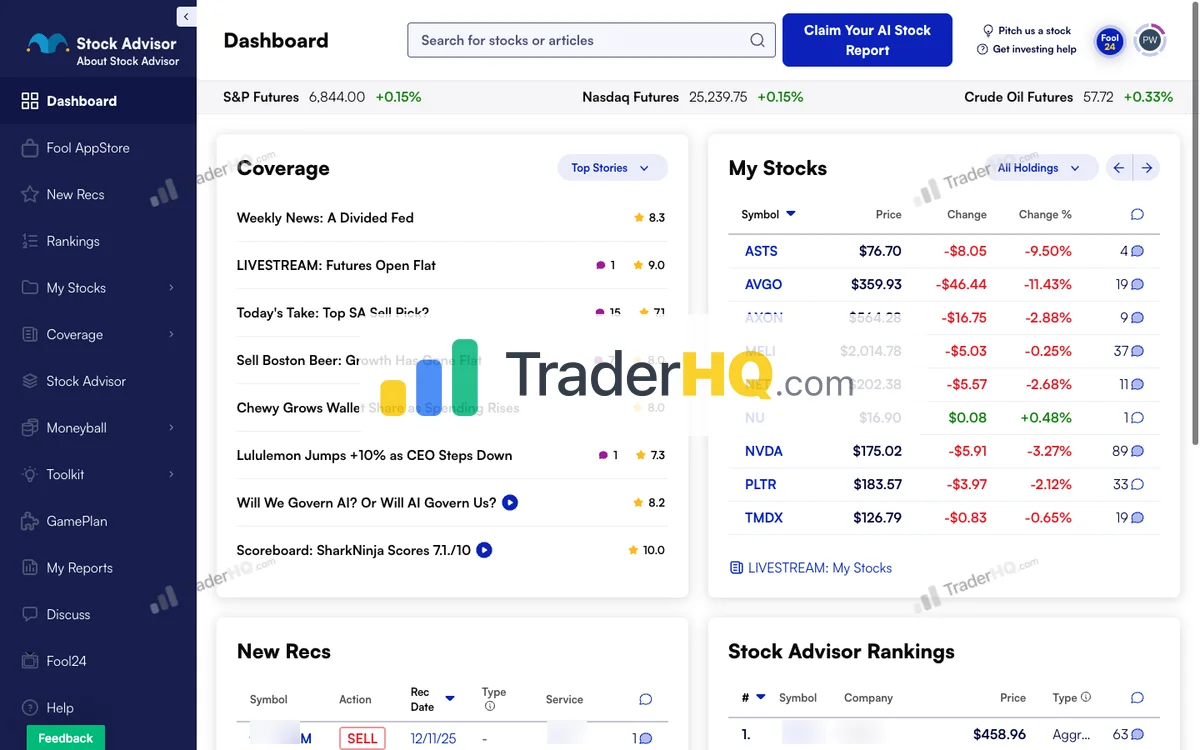
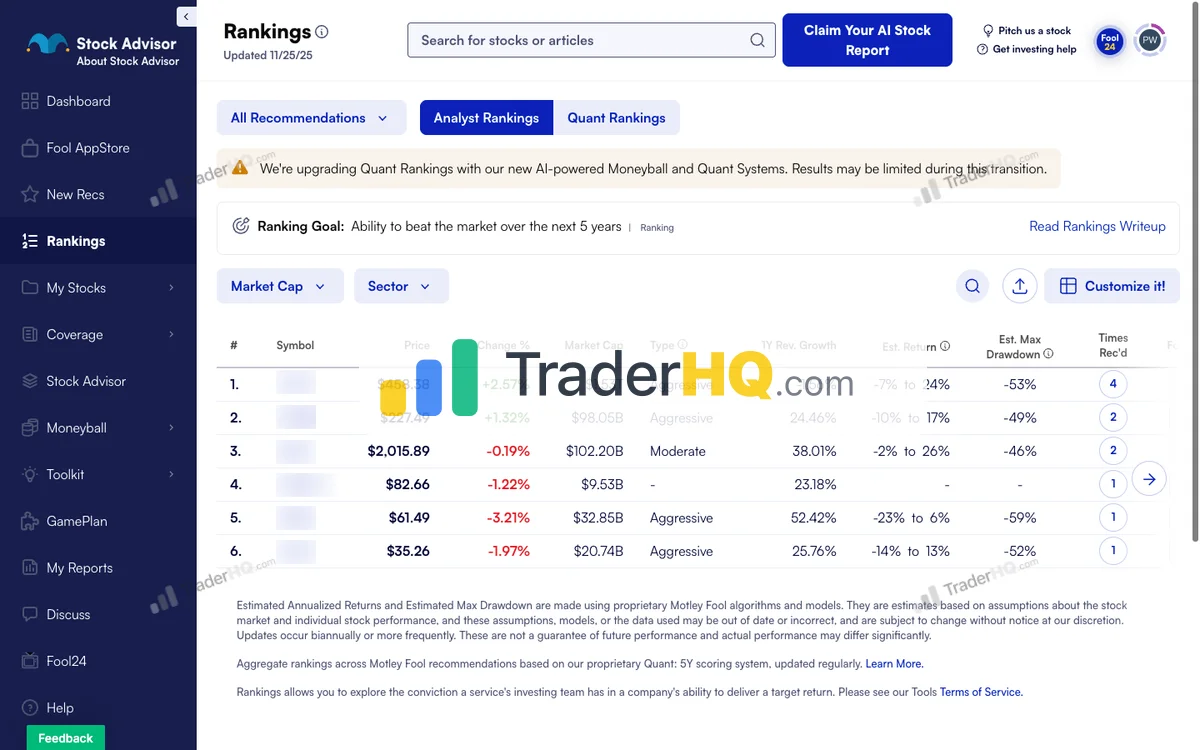
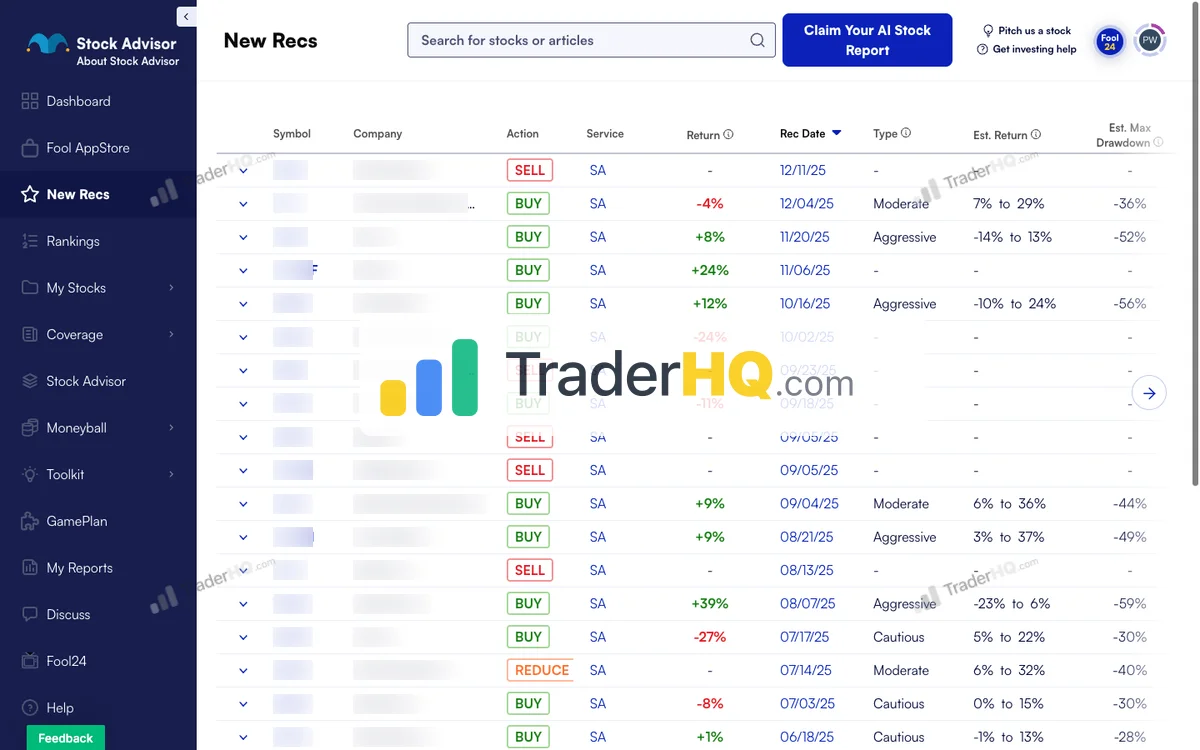
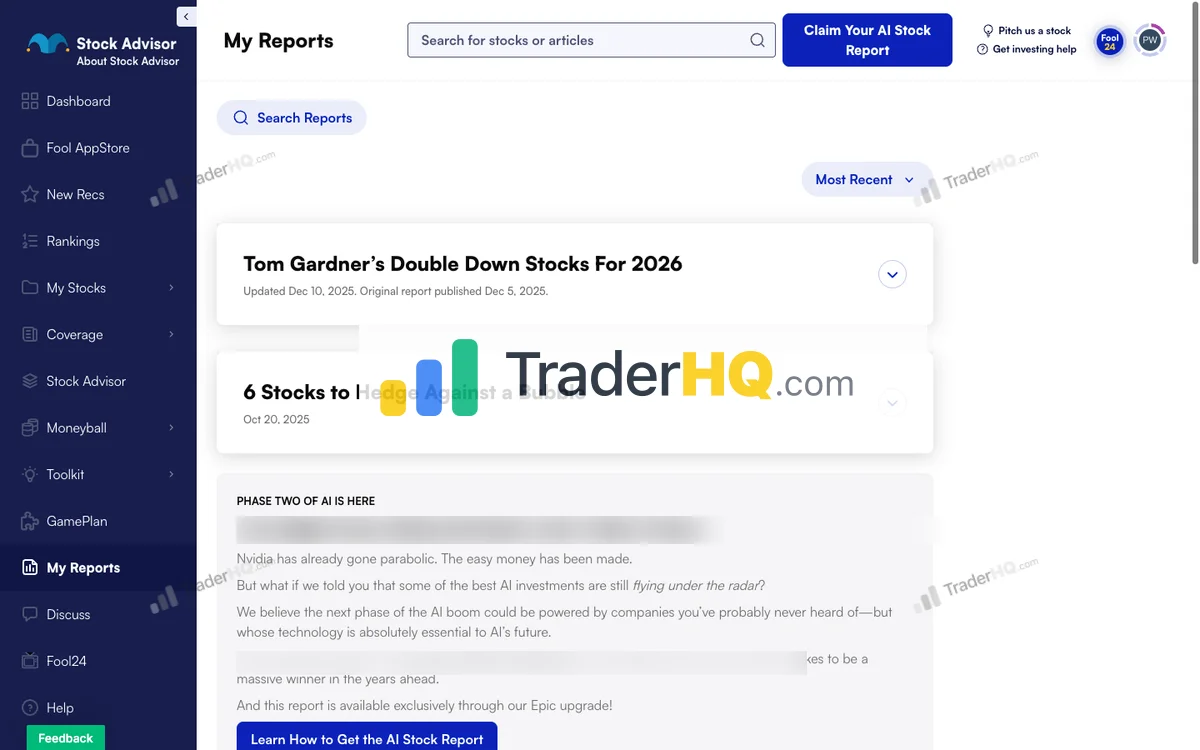
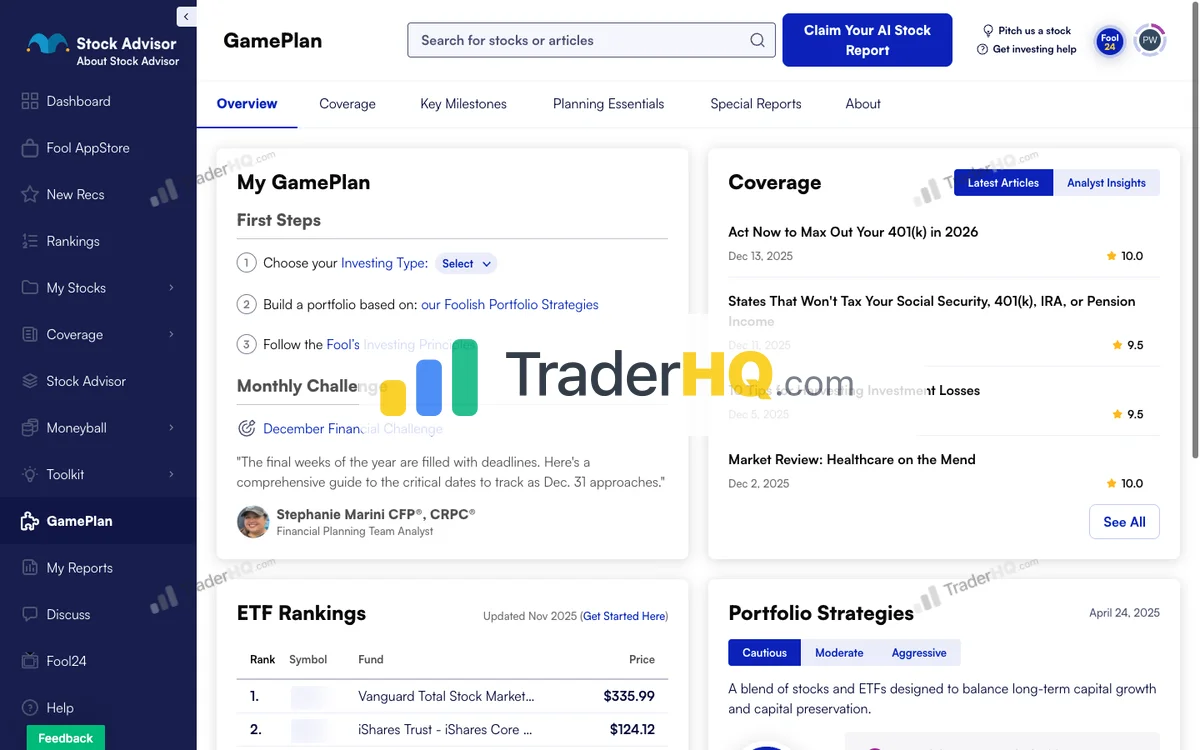
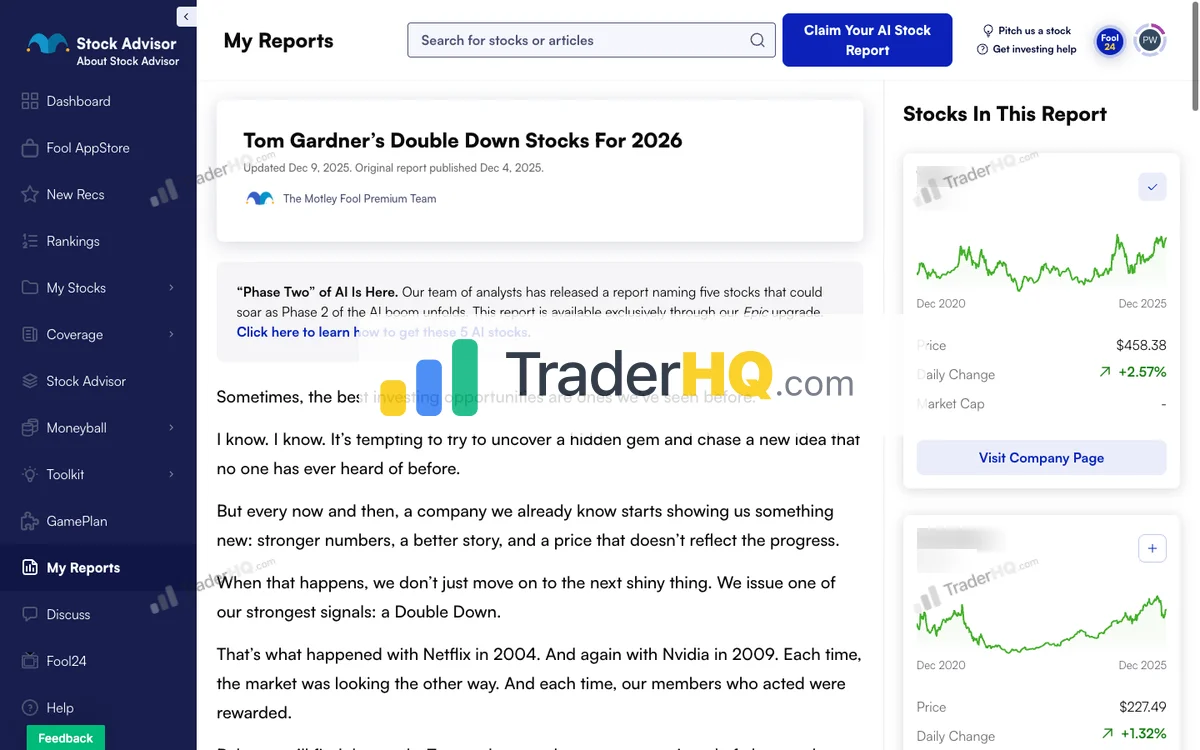
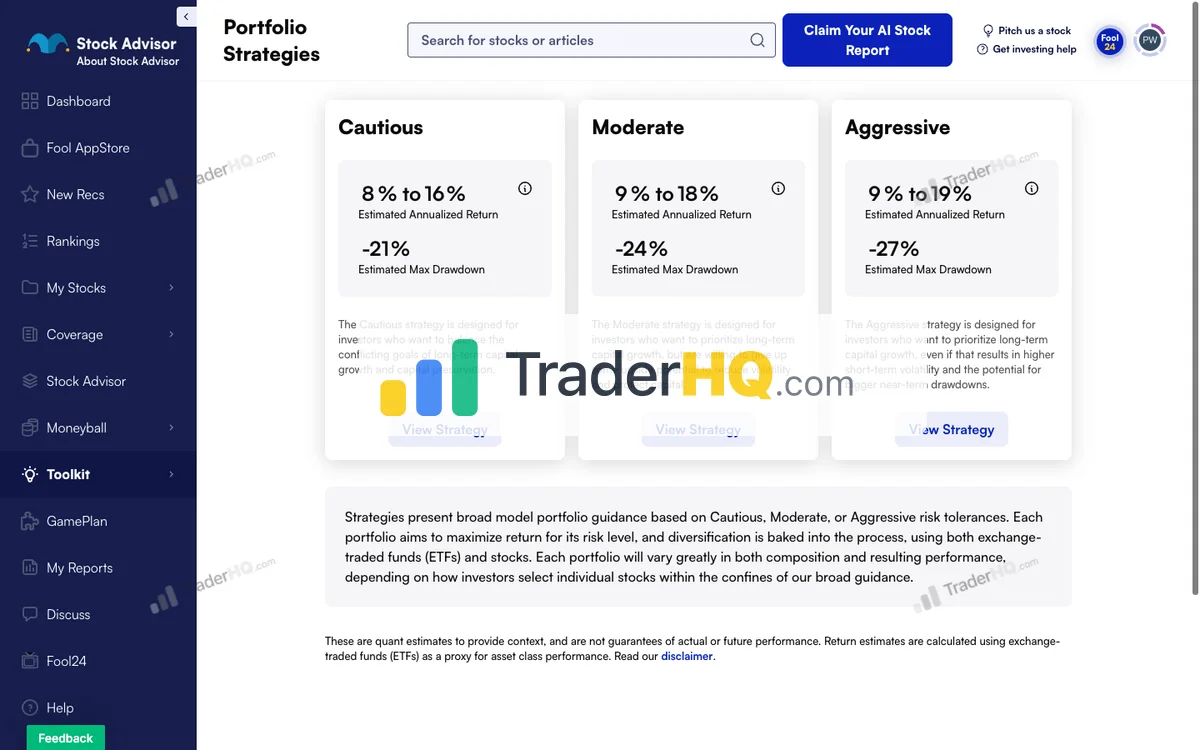
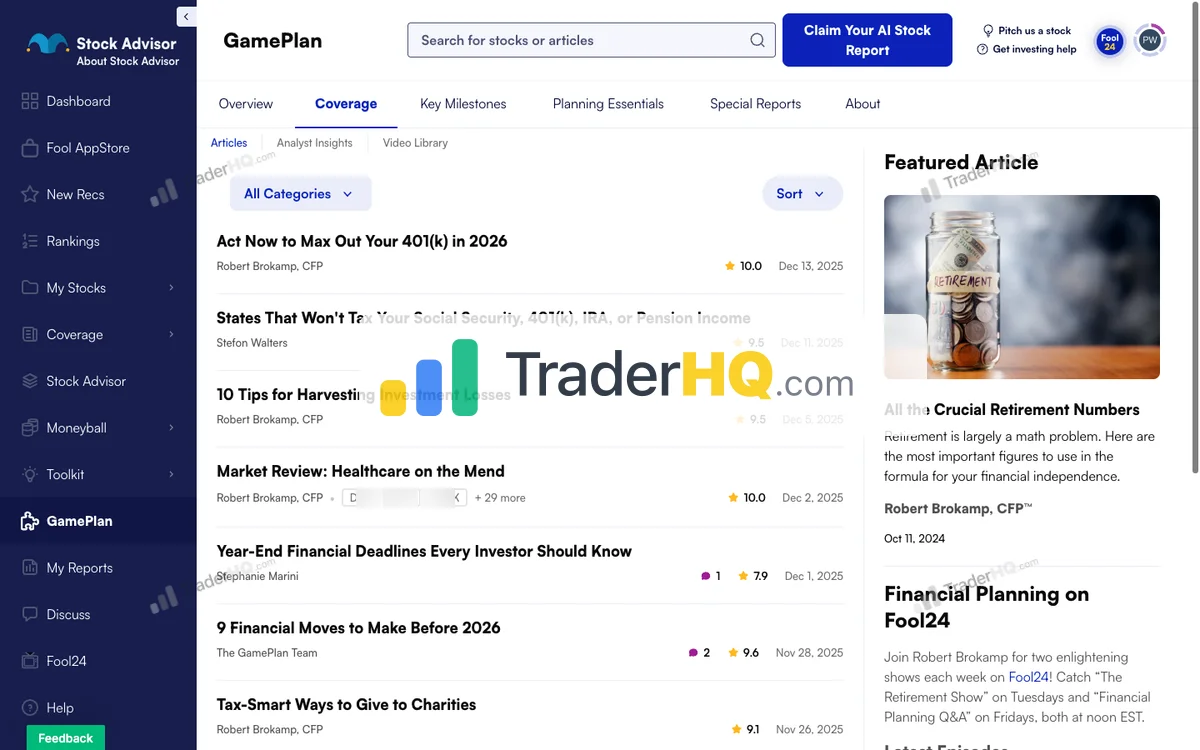
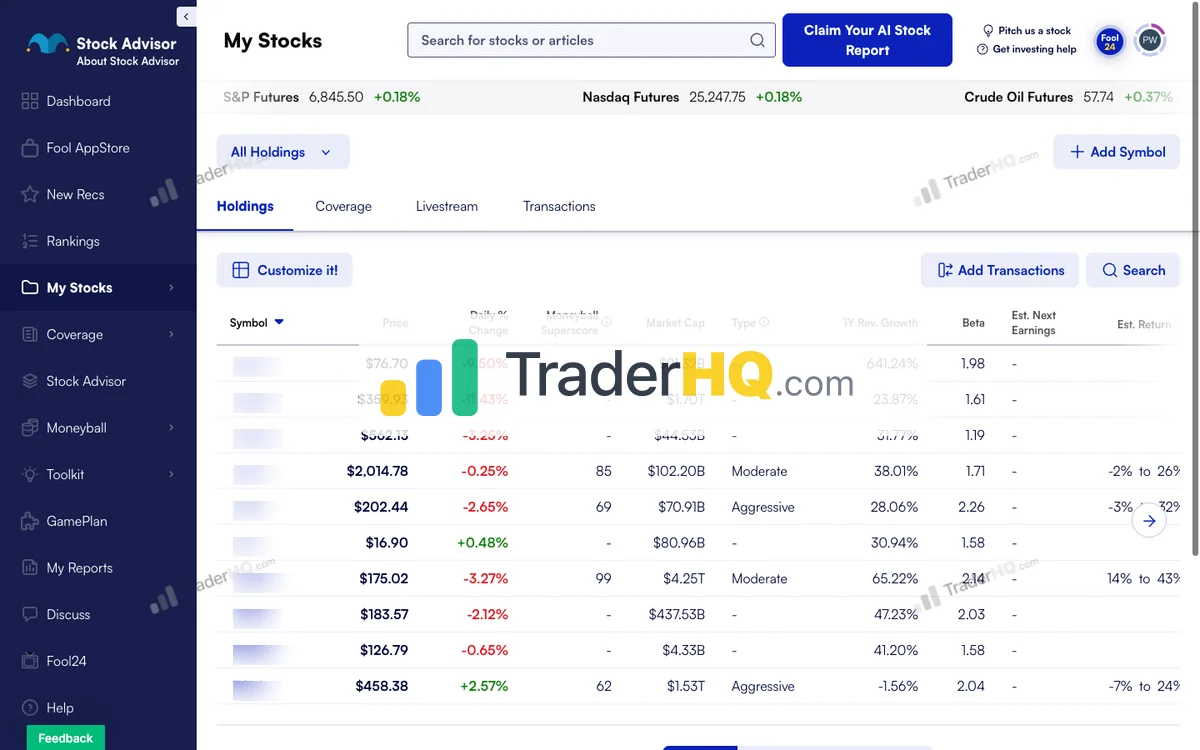
9 screenshots · Click to expand
The Track Record: What the Numbers Actually Mean
Two books. Labeled.
Official Fool.com scorecard (August 14, 2026): +981% vs S&P +216%. Live book: 286 actives out of 523 consolidated positions, 66% win rate, 49 ten-baggers, 173 doublers, 24.5 years since March 2002.
Last independent TraderHQ audit (February 18, 2026): +888.4% vs S&P +193.4%, 504 positions, 65% win, 42 ten-baggers. That audit is labeled and stale until the next scrape. Do not mash the two books together.
Let me make the official book visceral: $10,000 following Stock Advisor since 2002 would be worth approximately $108,070 today. The same money in an S&P 500 index fund? About $31,630. That’s a $76,000 gap from the same starting capital — and that is the official scorecard, not a backtest.
The time curve tells the real story (live book):
- 66% overall win rate across all picks
- 63.6% win rate and +207.6% average return once a pick has been held 5–10 years
- 92.9% win rate for 10+ year holds — 49 ten-baggers, 173 doublers
- Best for investors with 5+ year horizons who can hold through volatility
That’s not marketing spin. Every pick since 2002 is visible in their scorecard. The transparency is exceptional.
But here’s what the marketing doesn’t tell you:
- About 34% of Stock Advisor picks lose money. Winners average +1,702%. Losers average −44.8%. The math only works if you let the winners run.
- The returns are concentrated in the winners. Selling winners early — or panic-selling during drawdowns — destroys the book. NVIDIA (recommended 2005, +138,096%) and Netflix (2004, +42,051%) both crashed 50-80% along the way.
- The 2021 vintage is still the scar. That year averaged −12% with a 27% win rate. If you subscribed during the growth-stock mania, your personal scorecard does not look like +981%. The methodology did not break. Your entry year did.
This isn’t a criticism — it’s the reality of growth investing. The question is whether you can hold through the pain.
How Stock Advisor Actually Works
Stock Advisor delivers 2 new stock recommendations per month from Motley Fool’s analyst team. Each comes with:
- A full thesis explaining why this company can compound for decades
- Quantitative projections with estimated return ranges and maximum drawdown estimates
- Risk classifications so you know what you’re signing up for
- Re-recommendation signals when existing picks become even more attractive
But here’s what separates Stock Advisor from basic stock-picking newsletters: the portfolio framework.
The Real Product: Portfolio Construction, Not Just Picks
Most subscribers think they’re paying for stock tips. They’re actually paying for a complete portfolio-building system:
Three Portfolio Strategies:
- Cautious Portfolio — Lower volatility, more established companies, for investors who can’t stomach 50% drawdowns
- Moderate Portfolio — Balanced approach, mix of growth and stability
- Aggressive Portfolio — High-conviction growth picks, expect significant volatility
This matters because even the best picks are worthless if you can’t hold them. The portfolio strategies address the psychological reality that most investors sell at exactly the wrong time — and 2026’s software wreckage (INTU −48%, CRM −26%, ADBE −25%) is exactly the kind of tape that produces those sales.
Foundational Stocks:
Stock Advisor maintains a list of 10 highest-conviction core holdings with explicit risk classifications. New subscribers often ask “where do I start?” This is the answer. These aren’t the picks with the highest potential returns — they’re the ones the team would stake their reputation on. In a 211-point year, starting with the highest-conviction names beats trying to own all 24 new recommendations.
The Moneyball Database:
This is the hidden gem most subscribers never discover. The Moneyball database covers 344 companies with 12+ scoring dimensions. It’s essentially a research platform that helps you evaluate stocks on your own — building investor capability rather than dependency.
Why Most Subscribers Fail
Stock Advisor’s track record is real. But most subscribers don’t capture it. Here’s why:
1. They can’t hold through drawdowns.
Stock Advisor picks are growth stocks. Growth stocks are volatile. The service’s best performers — Netflix, Amazon, Nvidia — have all crashed 50-80% at some point. If you sold during those crashes, you missed the recovery. This year’s software names are running the same test in real time.
2. They sell winners too early.
When a position doubles, the instinct is to take profits. But Stock Advisor’s math depends on letting winners run. Selling Netflix at +100% would have forfeited thousands of percent in future gains. The live book has 173 doublers and 49 ten-baggers. Those are not the same 49 stocks — the ten-baggers were doublers that nobody clipped.
3. They joined at the wrong time.
Subscribers who joined in 2020-2021 bought at peak growth-stock valuations. Many of those picks are still down 50-70%. The 24.5-year track record is real, but your personal track record depends on when you started — and on whether you kept adding through the ugly vintages.
4. They ignore the framework.
Stock Advisor isn’t “buy these 2 stocks every month.” It’s a system with portfolio strategies, position sizing guidance, and re-recommendation signals. Subscribers who cherry-pick stocks without following the framework consistently underperform. The recommendation cadence is a marketing feature. The Best Buys Now list is the investing feature.
Who Stock Advisor Is For
- Patient investors with 5+ year horizons. This is non-negotiable. If you need the money in 2-3 years, Alpha Picks or index funds are the cleaner match.
- Portfolios of $25,000+. At smaller sizes, the $199/year fee (or $99 promo) represents too large a percentage of your capital.
- Investors who can stomach 30-50% drawdowns. Not theoretically — actually. When your portfolio drops 40%, will you hold or sell?
- People who want a framework, not just tips. If you’ll follow the portfolio strategies and position sizing guidance, Stock Advisor works. If you’ll cherry-pick stocks and panic-sell, save your money.
Who Stock Advisor Is NOT For
- Short-term traders. The average holding period is 6.9 years. If you’re looking for swing trades, look elsewhere — IBD Leaderboard is a trading system with stops, not a 10-year compounder.
- Income investors. Stock Advisor focuses on growth, not dividends. If you need current income, this isn’t your service.
- Investors who hate upsells. The Motley Fool will try to upgrade you to Epic, Epic Plus, and beyond. Relentlessly. If this frustrates you, be warned.
- People who subscribed in 2020-2021 and are frustrated. Your experience is valid. But the solution isn’t to quit — it’s to hold. The 24.5-year track record includes multiple periods that looked just as bad.
Pricing and Value
- Regular Price: $199/year
- New Member Price: $99/year (50% off)
- Refund Policy: 30-day money-back guarantee
At $99/year, you’re paying roughly $4 per stock pick for recommendations backed by 24.5 years of market-beating performance. Compare that to:
- A single hour with a financial advisor: $200-400
- An actively managed mutual fund with 1% expense ratio on $100K: $1,000/year
- The cost of one bad stock pick: Potentially thousands
The math works. The 30-day guarantee is the part most people underuse — you can read the full scorecard, sit with a couple of theses, and leave if the temperament test fails. The question is whether you’ll follow the system.
The Bottom Line on Stock Advisor
Motley Fool Stock Advisor isn’t perfect. The upsell pressure is annoying. The 2021 vintage is still a scar. And about a third of recommendations lose money.
But the 24.5-year track record is real, verified, and transparent — official +981% vs the S&P’s +216%, with 49 ten-baggers and 173 doublers across 523 positions and 286 actives. Last independent audit (February 18): +888.4%. Either book, the point is the same. Quality GARP is how you participate in a hardware boom without marrying a software multiple that just got cut in half. At $99/year with a 30-day guarantee, the risk/reward is asymmetric in your favor.
Bottom line for Stock Advisor: Best for investors with 5+ year horizons in a market where the index already got paid and the 211-point gap is the actual story. The 92.9% win rate on 10+ year holds and 49 ten-baggers prove the methodology works for patient investors — especially when forward index returns are compressed to 5-8%.
If you’re going to try one stock advisory service, this is it.
For a deeper analysis, read our complete Stock Advisor review. Wondering how it compares to the competition? See our Stock Advisor vs Alpha Picks comparison.
Explore Motley Fool Stock Advisor’s Track Record
2. Alpha Picks by Seeking Alpha — The Quant Challenger

Data-driven investors who trust algorithms over human opinion
Alpha Picks is the #2 service on this list for a specific investor, not a general one. If your horizon is 1–3 years and you trust a factor model more than a narrative, this is the book. If you think in decades, it is a complement — not a replacement — for Stock Advisor.
The live, independently audited record is +378.5% versus +105.6% for the S&P 500 since July 2022, across 103 positions, with a 70% win rate. $10,000 following the book is $47,848. That is the current book. Do not mash it with older scorecards.
The live caution is sitting in the same scorecard as the trophy. APP, recommended in November 2023, is up +1,571% from the original rec — and −53% year-to-date. Quant rotation can lock in both the rise and the crash. That is the feature and the risk.
Alpha Picks by Seeking Alpha Performance
Seeking Alpha · 103 picks · 4 years · Updated 2026-08-15
| AP Return | S&P 500 | Alpha | Win Rate |
|---|---|---|---|
| +379% | +106% | +273% | 70% |
S&P 500 shows what you'd have earned buying the index on each pick date instead. Same timing, fair comparison.
| AP Multi-Baggers | 10x+ | 5x+ | 3x+ | 2x+ |
|---|---|---|---|---|
| Count | 2 | 4 | 12 | 19 |
| AP Asymmetry | Avg Winner | Avg Loser | Ratio |
|---|---|---|---|
| Return | +129% | -21% | ~6:1 |
Best Performers (All-Time)
| AP Pick | Return |
|---|---|
**** Memory Chips | +409% |
**** Connectivity Chips | +277% |
**** Thermal Management | +348% |
 SMCI Super Micro Computer | +969% |
**** Power Plant Construction | +387% |
 STRL Sterling Construction | +823% |
 APP AppLovin | +1.6K% |
**** Casual Dining | +363% |
 CLS Celestica | +1.2K% |
 POWL Powell Industries | +1.1K% |
Latest Alpha Picks Picks
Tickers masked to protect subscriber value. Recent picks need 3-5+ years to demonstrate thesis.
| AP Pick | Return |
|---|---|
**** Memory Chips | +409% |
**** Circuit Board Manufacturing | +137% |
**** Growth Company | +75% |
**** Growth Company | +75% |
**** Connectivity Chips | +44% |
**** Growth Company | +43% |
**** Gold Mining | +28% |
**** Growth Company | +23% |
**** Growth Company | +14% |
**** Growth Company | +10% |
Alpha Picks Win Rate by Holding Period
| Hold Time | AP Win Rate | Avg Return |
|---|---|---|
| < 1 Year | 56.1% | +14% |
| 1-3 Years | 77.6% | +102% |
| 3-5 Years | 100% | +529% |
| 5-10 Years | N/A% | N/A |
| 10+ Years | N/A% | N/A |
Alpha Picks Performance by Year
| Year | AP Picks | Avg Return | Win Rate | |
|---|---|---|---|---|
| 2026 | 15 | +3% | 60% | CRDO+44% |
| 2025 | 24 | +63% | 75% | MU+409% |
| 2024 | 24 | +75% | 67% | AGX+387% |
| 2023 | 24 | +177% | 71% | CLS+1.1K% |
| 2022 | 16 | +65% | 75% | MOD+348% |
Inside Alpha Picks
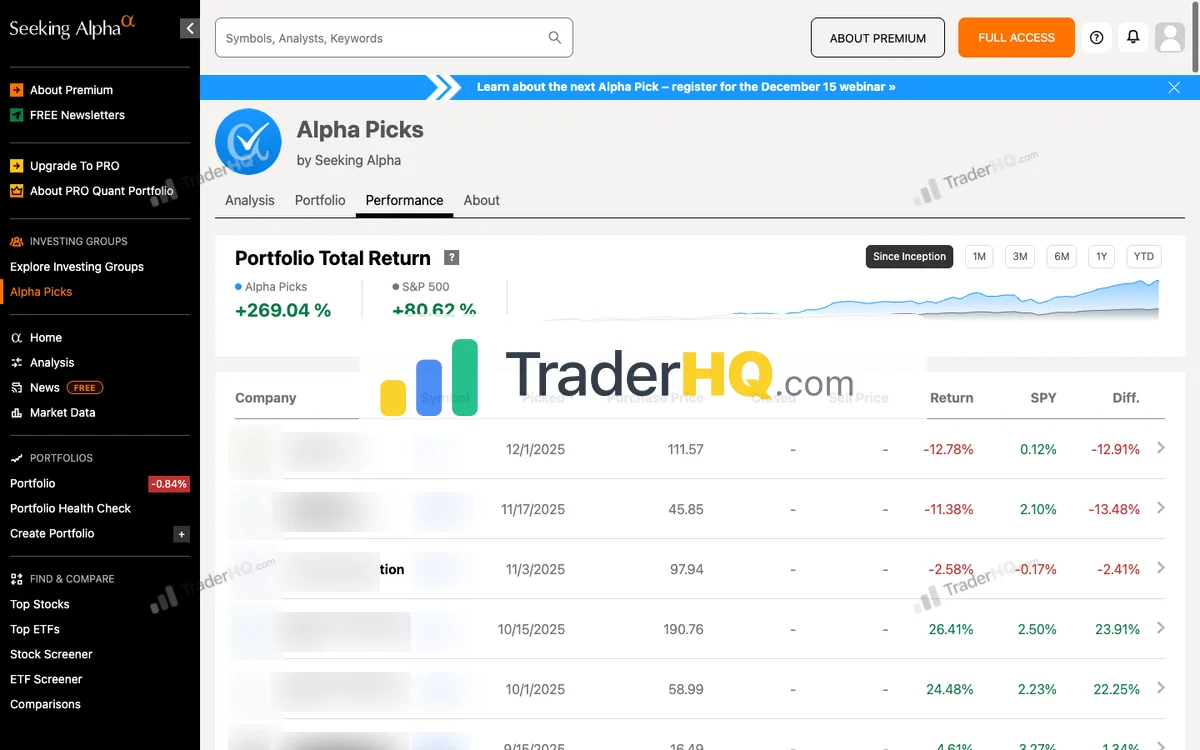
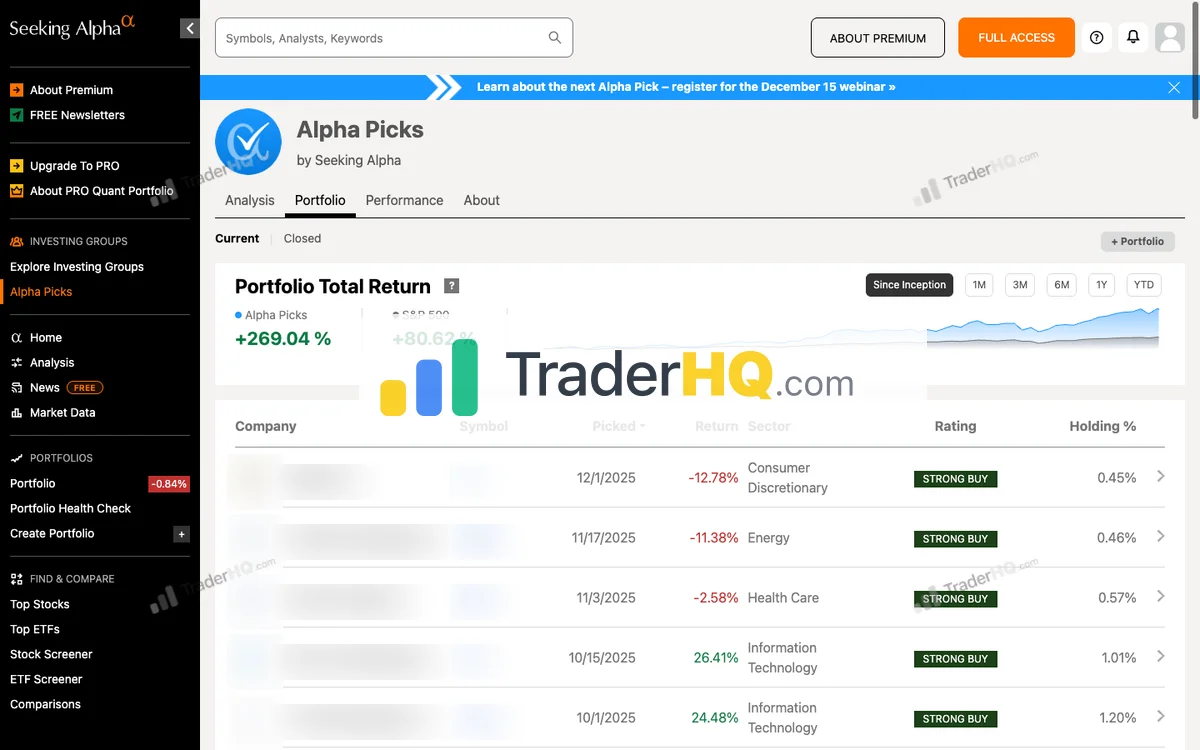
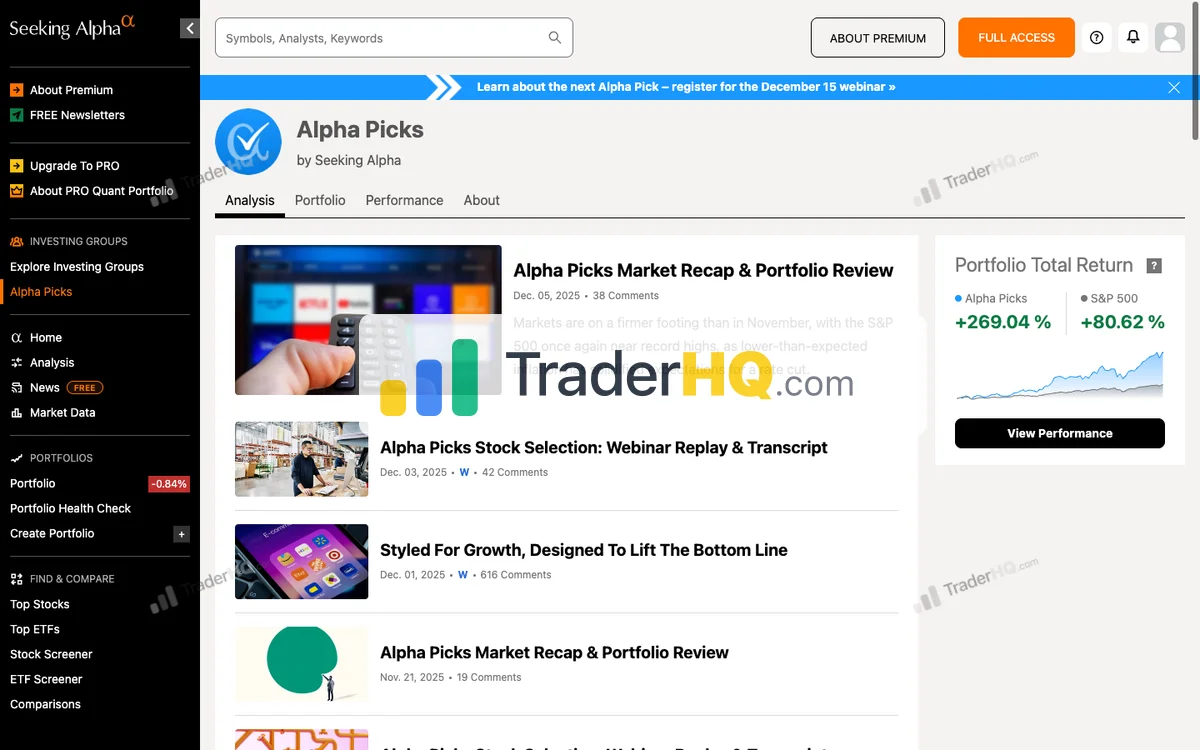
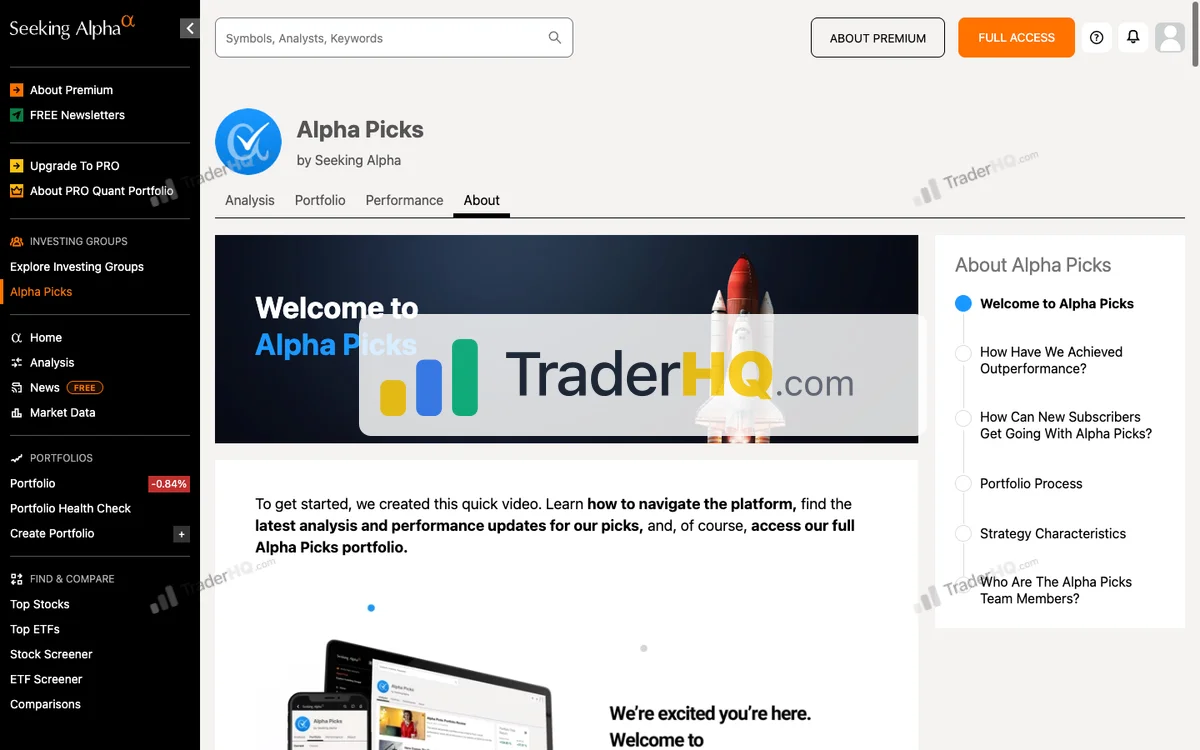
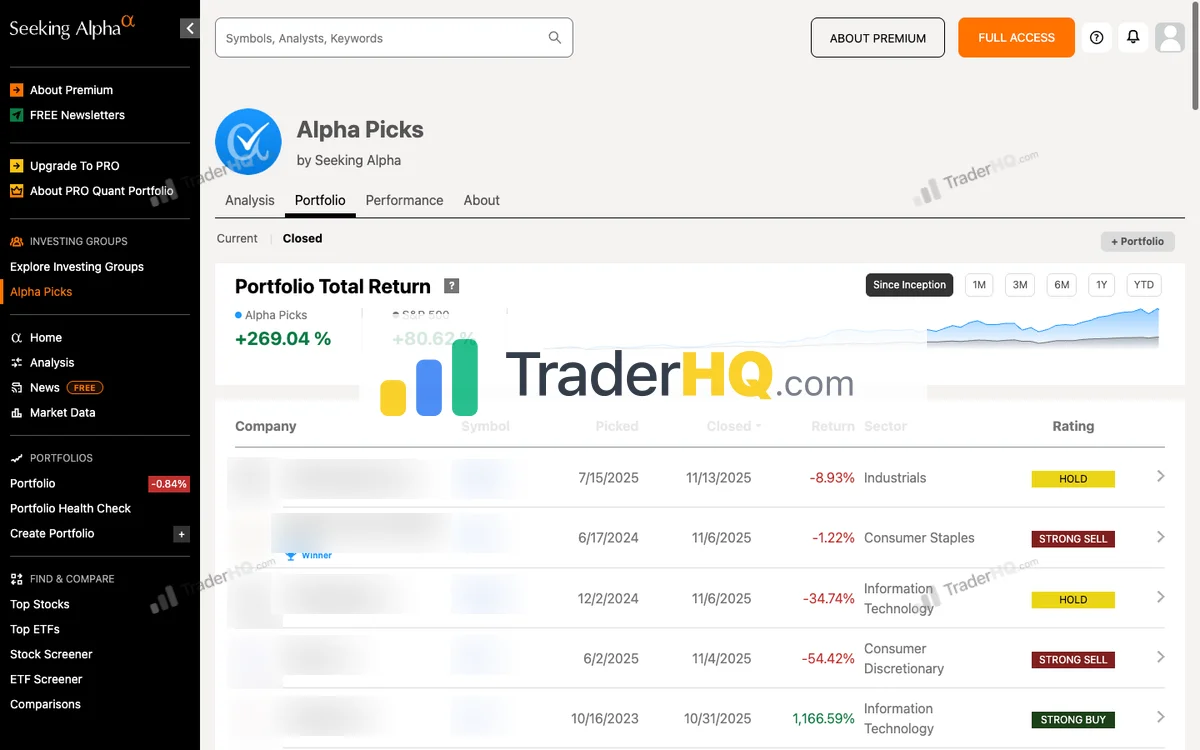

6 screenshots · Click to expand
The Track Record: Shorter But Impressive
- +378.5% total return since July 2022 (vs S&P 500 +105.6%) — across 103 positions
- 70% overall win rate — 72 winners, 31 losers
- 84% active win rate — among the 51 current open positions
- 77.6% win rate for 1-3 year holds — the sweet spot for this service, with +102.4% average returns in that bucket
- 4 ten-baggers already in 4.1 years, including APP and Celestica
- Winners average +128.9%. Losers average −20.9%. The loss side is tighter than most human-analyst books — because the model sells.
The shorter track record (4.1 years vs Stock Advisor’s 24.5) is a legitimate caveat. Alpha Picks has a 2022 bear-market sample. It has not been through a full consumer-led recession. The methodology is designed to work across cycles. The tape it has actually lived in is an AI bull market with a 211-point stock-level civil war — exactly the environment a factor model is supposed to exploit.
Key insight: Alpha Picks is optimized for 1-3 year holding periods. If your horizon is shorter or much longer, consider other options.
How Alpha Picks Works
Alpha Picks uses Seeking Alpha’s proprietary Quant Rating system to identify stocks with statistical edge. The algorithm analyzes:
- Valuation metrics
- Growth factors
- Profitability measures
- Momentum indicators
- Earnings revisions
Two new picks per month. No human discretion in selection — the algorithm identifies the highest-rated stocks, period.
That design is why the service can own Micron (+409% from the October 2025 rec) in a memory boom and also why it will not “talk you through” a 50% drawdown in a former winner. There is no Tom Gardner on the other end of the thesis. There is a model, a rank, and a sell.
The Time Curve: Why Patience Pays
This is the most important insight about Alpha Picks:
| Holding Period | Win Rate | Average Return |
|---|---|---|
| Under 1 year | 56.1% | +14% |
| 1-3 years | 77.6% | +102.4% |
| 3-5 years | 100% | +528.6% |
The 1–3 year window is where this service earns its rank. Selling early would have cost 63.9% of total returns. The 3–5 year bucket is tiny — only four positions — so do not build a 10-year plan on it.
This is why we recommend Alpha Picks for 1-3 year horizons. The 77.6% win rate in that window is exceptional. For longer horizons (5+ years), Stock Advisor’s methodology becomes more compelling — it has the 10+ year cohort Alpha Picks does not.
Who Alpha Picks Is For
- Data-driven investors who trust algorithms over human opinion
- Patient holders who can commit to 1-3+ year holding periods
- Investors who want transparency — every position visible, winners AND losers
- Those seeking systematic, emotion-free investing
- Investors who can live with a model selling a winner — because that is the product
Who Alpha Picks Is NOT For
- Investors who want to understand why — the algorithm is a black box
- Those who need portfolio guidance — no construction framework, just picks
- Investors who think in decades — 4.1-year track record, no 5–10 or 10+ year cohort
- Anyone who needs a money-back guarantee — Alpha Picks doesn’t offer one. Annual billing. No refund.
Pricing
- Regular Price: $499/year
- New Member Price: $449/year (10% off)
- Refund Policy: None (annual billing only)
At $449/year with no refund policy, this stock advisor requires more commitment than Stock Advisor’s $99 / 30-day structure. Read that twice. You are prepaying a year for a model that will not give the money back if you hate the first two picks. The +378.5% total return, 70% win rate, and 4 ten-baggers in 4.1 years justify the premium for data-driven investors with 1-3 year horizons. They do not justify it for someone who wants a trial.
Caveat: Only 4.1 years of data — untested in a consumer-led slowdown or full recession. VIX ~14 and an S&P at ~7,600 can make a 4-year quant book look inevitable. A 9–3 FOMC with hike dissenters and CPI at 3.4% is the regime-change risk. Stock Advisor’s 24.5-year track record through 2008, 2020, and 2022 provides more confidence for long-term (5+ year) investors.
For our complete analysis, see our Alpha Picks review. Curious how it stacks up against other stock advisors? Check our Alpha Picks vs Mindful Trader comparison.
Explore Seeking Alpha Alpha Picks’ Performance
3. Motley Fool Rule Breakers — The Aggressive Growth Play
Rule Breakers is Stock Advisor’s aggressive sibling — same Motley Fool DNA, but hunting for disruptive innovators before they become obvious. We rank it third, not because the book is weak, but because it is a specialist sleeve: disruptors you can actually hold.
Official scorecard: +318% versus +187% for the S&P 500 since 2004, 219 positions, 75% win rate, 37 ten-baggers. Tesla, recommended in November 2011, is up +16,224%. MercadoLibre +12,956%. Intuitive Surgical +7,938%. That is the multi-bagger engine.
2026 is supposed to be their tape — and it is, on one side of tech. Memory, storage, and semiconductor equipment are printing the kind of returns Rule Breakers exists to find. The other side of the same sector is a graveyard. Rule Breakers’ own April 2024 Trade Desk rec is down −83%. The service does not get a pass on software just because the category is “innovation.”

Motley Fool Rule Breakers Performance
The Motley Fool · 219 picks · 22 years · Updated 2026-08-15
| RB Return | S&P 500 | Alpha | Win Rate |
|---|---|---|---|
| +318% | +187% | +131% | 75% |
S&P 500 shows what you'd have earned buying the index on each pick date instead. Same timing, fair comparison.
| RB Multi-Baggers | 10x+ | 5x+ | 3x+ | 2x+ |
|---|---|---|---|---|
| Count | 37 | 66 | 93 | 108 |
| RB Asymmetry | Avg Winner | Avg Loser | Ratio |
|---|---|---|---|
| Return | +911% | -38% | ~24:1 |
Best Performers (All-Time)
| RB Pick | Return |
|---|---|
 MNST MNST | +3.3K% |
 MELI MercadoLibre | +13K% |
 ISRG Intuitive Surgical | +7.9K% |
 VRTX Vertex Pharma | +4.7K% |
 ANET Arista Networks | +4.2K% |
SHOP Shopify | +7.2K% |
 AVGO Broadcom | +3.2K% |
TSLA Tesla | +16K% |
 GOOGL Alphabet (Google) | +3.1K% |
 PANW Palo Alto Networks | +3.2K% |
37 ten-baggers. These 1,000%+ winners—NVDA, NFLX, AMZN—are what drive the portfolio. You don't need to pick all winners; you need a few massive ones.
See All Rule Breakers Recommendations →Latest Rule Breakers Picks
Tickers masked to protect subscriber value. Recent picks need 3-5+ years to demonstrate thesis.
| RB Pick | Return |
|---|---|
**** Life Sciences Software | +45% |
**** Growth Company | +23% |
**** Growth Company | +20% |
**** Growth Company | +16% |
**** Growth Company | +5% |
**** Growth Company | +4% |
**** Social Platform | -4% |
**** Growth Company | -9% |
**** RNA Therapeutics | -20% |
**** Growth Company | -31% |
Early results mislead. < 1 year: 46.2% win rate. 10+ years: 98.6%. That 52-point gap explains why judging picks early leads to selling future winners.
Rule Breakers Win Rate by Holding Period
| Hold Time | RB Win Rate | Avg Return |
|---|---|---|
| < 1 Year | 46.2% | -4% |
| 1-3 Years | 61.3% | +45% |
| 3-5 Years | 56.4% | +65% |
| 5-10 Years | 72.3% | +211% |
| 10+ Years | 98.6% | +1.8K% |
Time is the strategy. 10+ year picks show 98.6% win rate with +1.8K% average returns. Same methodology, same picks—time transforms the results.
Rule Breakers Performance by Year
| Year | RB Picks | Avg Return | Win Rate | |
|---|---|---|---|---|
| 2026 | 8 | +4% | 63% | VEEV+45% |
| 2025 | 12 | +2% | 42% | BBIO+99% |
| 2024 | 17 | +55% | 65% | GH+415% |
| 2023 | 19 | +72% | 63% | CRWD+657% |
| 2022 | 19 | +77% | 63% | ANET+667% |
| 2021 | 17 | +35% | 41% | CRWD+214% |
| 2020 | 13 | -14% | 38% | ISRG+102% |
| 2019 | 14 | +121% | 64% | DDOG+686% |
| 2018 | 13 | +417% | 92% | MDB+1.3K% |
| 2017 | 10 | +380% | 100% | TWLO+720% |
| 2016 | 14 | +1.4K% | 100% | SHOP+7.2K% |
| 2015 | 5 | +663% | 80% | AXON+2.5K% |
| 2014 | 11 | +1.1K% | 100% | ANET+4.2K% |
| 2013 | 8 | +463% | 100% | AX+941% |
| 2012 | 8 | +1.4K% | 100% | META+2.5K% |
| 2011 | 4 | +4.5K% | 100% | TSLA+16K% |
| 2010 | 2 | +335% | 100% | OLED+437% |
| 2009 | 7 | +3.5K% | 100% | MELI+13K% |
| 2008 | 4 | +1.6K% | 100% | ISRG+2.8K% |
| 2007 | 7 | +1.1K% | 100% | CMG+2.7K% |
| 2006 | 1 | +3.4K% | 100% | ISRG+3.4K% |
| 2005 | 6 | +3.4K% | 100% | ISRG+7.9K% |
The Track Record: Asymmetric Math
- +318% cumulative return since 2004 (vs S&P 500 +187%) over 21.9 years
- 75% historical win rate — 164 winners, 55 losers
- 108 positions doubled
- 37 ten-baggers with an innovation thesis
- 219 total positions — the live Rule Breakers book, not a 300+ mash-up
Here’s the asymmetric math that makes Rule Breakers work:
- Winners average +911%
- Losers average −38%
The asymmetry is massive. Selling winners at +100% would forfeit 92.4% of total returns. That is not a slogan. That is the what-if on this book.
The Time Curve: Patience Is the Strategy
| Holding Period | Win Rate | Average Return |
|---|---|---|
| First year | 46.2% | −4.3% |
| 1-3 years | 61.3% | +44.8% |
| 5-10 years | 72.3% | +211.4% |
| 10+ years | 98.6% | +1,827% |
Time horizon isn’t a suggestion — it’s the entire strategy. First-year picks are a coin flip, and they start slightly underwater. Hold for a decade, and you’re looking at near-certain gains with four-digit average returns. If you cannot do that, do not buy this sleeve. Buy Stock Advisor, or buy the index.
How Rule Breakers Works
Rule Breakers focuses on disruptive innovation: companies breaking the rules of their industries. Think early Amazon, Netflix, Tesla — and, this year, the picks-and-shovels of the AI buildout rather than every software multiple that used the same story.
2 new picks per month with:
- Estimated return ranges
- Maximum drawdown estimates
- Risk classifications
- A written disruption thesis
Important: Rule Breakers is no longer available as a standalone subscription. It’s bundled in Motley Fool Epic ($299/year), which includes Stock Advisor, Rule Breakers, Hidden Gems, and Dividend Investor.
Who Rule Breakers Is For
- Aggressive growth investors with genuine 5+ year horizons
- High risk tolerance — expect 50%+ drawdowns on individual positions
- Believers in disruptive innovation as an investment thesis — and willing to tell hardware from software
- Investors who already have Stock Advisor and want more aggressive exposure
Who Rule Breakers Is NOT For
- Income investors — these are growth stocks, not dividend payers
- Short-term traders — the math requires years to work
- Those who subscribed 2020-2021 and are frustrated — many picks are still down 70%+
- Investors who can’t handle positions down 80-90% — it happens. UPST is −91%. Trade Desk is −83% from the 2024 rec.
Pricing
- Price: $299/year (via Epic bundle)
- Includes: Stock Advisor + Rule Breakers + Hidden Gems + Dividend Investor
- Refund Policy: 30-day money-back guarantee
The Epic headline is the Stock Advisor book — official +981% vs +216%. That is not a separate Epic alpha number. Across the bundle you get 713 unique recommendations. Hidden Gems is +65% vs S&P +79%. Dividend Investor is +22% vs +69%. You are paying $299 for the SA engine, the Rule Breakers sleeve, and two additional scorecards that have not beaten the index. The incremental $200 over standalone Stock Advisor is the price of more names and the disruptor book — not a promise that every Fool scorecard prints SA-like returns.
For the complete breakdown, see our Rule Breakers review. Still deciding between the two Motley Fool stock advisors? Read Stock Advisor vs Rule Breakers.
See What’s Inside Motley Fool Epic
4. Morningstar Investor — The DIY Research Platform

Morningstar Investor is fundamentally different from other stock advisors on this list. It’s not a stock-picking service — it’s a research platform that gives you the tools to make your own decisions.
This is exactly when fair-value work earns the fee — not because the index is cheap after +14.54%, but because it isn’t. Software names down 25–60% are either bargains or traps. At CAPE ~41–42, you need to know what a stock is actually worth, not just what the market is willing to pay.
If you want someone to tell you what to buy, skip to the next entry. If you want to become a better investor, keep reading.
What You Get
Fair Value Estimates:
Morningstar’s proprietary valuation methodology estimates what each stock is actually worth. When market price is below Fair Value, you’re potentially buying at a discount.
Economic Moat Ratings:
Morningstar pioneered the concept of “economic moats”—competitive advantages that protect companies from competition. Wide moat companies can maintain pricing power and profitability for decades.
Portfolio X-Ray:
Upload your holdings and see your true allocation, performance, fees, and overlaps. This alone is worth the subscription for serious investors.
200+ Data Points for Screening:
Build custom screens based on valuation, growth, profitability, momentum, and hundreds of other factors.
The Track Record Question
Morningstar Investor doesn’t have a “track record” because it doesn’t make stock picks. It’s a research tool, not an advisor.
That said, Morningstar’s ratings methodology has been trusted for 40+ years and is recession-tested across multiple market cycles. Their quality/moat focus and fair value methodology is the industry standard for fundamental analysis. At CAPE ~41–42 with forward index returns compressed to 5-8%, knowing the fair value of what you’re buying isn’t just useful — it’s the difference between compounding and overpaying. Energy at roughly +38% YTD and a tech sector that is internally at war (hardware multi-baggers vs software 25–60% drawdowns) is exactly the tape a moat-and-fair-value framework was built for. For DIY researchers and value investors, this is the gold standard.
Who Morningstar Is For
- Self-directed investors who want professional-grade research tools
- DIY analysts who enjoy the research process
- Investors who want to understand why they’re buying, not just what
- Those building independent capability rather than following picks
Who Morningstar Is NOT For
- Investors who want someone to tell them what to buy — Morningstar won’t do that
- Beginners who need guidance — the learning curve is real
- Those seeking actionable stock picks — look at Stock Advisor or Alpha Picks instead
Pricing
- Regular Price: $249/year
- Trial: 7-day free trial
- Refund Policy: 7-day free trial, then annual billing
Morningstar is different from typical stock advisors—it’s a research platform. Read our Morningstar Investor review for the complete analysis.
Try It Free — See the Latest Research
5. 7investing — The Boutique Innovation Service

7investing is a solo analyst operation run by Simon Erickson, former Motley Fool Explorer Lead Advisor who managed over $1 million in real-money investments.
The value proposition for this stock advisor is simple: 1 high-conviction stock recommendation per month with deep research, direct analyst access, and zero upsells.
How 7investing Works
- 1 pick per month (vs 2 at most competitors)
- Video thesis with peer scrutiny
- Discord community for direct interaction with Simon
- Focus on disruptive innovation: AI, quantum computing, biotech, fintech
- 5+ year investment horizon
The Founder Credibility
Simon Erickson’s background is legitimate:
- Led team of 22 at Motley Fool
- Managed >$1 million in real-money investments
- Former Motley Fool Explorer Lead Advisor
- 15+ years of investment experience
The Trade-Offs
- Performance not publicly disclosed — scorecard available to members only
- Only 1 pick per month — half the volume of Stock Advisor or Alpha Picks
- Solo analyst model — all eggs in one basket
- 7-day trial only — no money-back guarantee
- Shorter track record — founded 2020
Who 7investing Is For
- Innovation enthusiasts with 5+ year horizons
- Investors who value direct analyst access and community engagement
- Those frustrated by upsells — 7investing has none
- People who want deep research on fewer picks
Who 7investing Is NOT For
- Bargain hunters — $199/year for 12 picks vs Stock Advisor’s 24
- Those needing immediate performance validation — no public track record
- Passive investors — requires engagement to get full value
Pricing
- Price: $199/year
- Refund Policy: 7-day free trial (no money-back guarantee)
6. Zacks Premium — The Earnings-Focused Quant

Zacks Premium is built on a single insight: earnings estimate revisions predict stock performance.
Founded in 1978 by Len Zacks (MIT PhD), this stock advisor service pioneered research on the predictive power of earnings revisions. The Zacks Rank system has been in continuous use since 1988—37+ years of real-world application as a stock advisor methodology.
How the Zacks Rank Works
Stocks are rated 1-5 based on earnings estimate revisions:
- 1 = Strong Buy — Analysts raising estimates aggressively
- 2 = Buy — Estimates trending higher
- 3 = Hold — Mixed signals
- 4 = Sell — Estimates declining
- 5 = Strong Sell — Analysts cutting estimates aggressively
The system updates daily based on new earnings estimate data. It’s purely quantitative—no human discretion in the ratings.
What They Claim
Zacks claims strong backtested performance, though specific numbers aren’t prominently displayed. The methodology is academically sound—the relationship between earnings revisions and stock performance is well-documented in financial research.
Where It Frustrates
- Overwhelming amount of content — Zacks throws everything at you
- Aggressive upselling to higher tiers (Ultimate, Black Box, etc.)
- Pricing not always transparent — promotional offers change frequently
- Research platform, not specific stock picks — you still have to do the work
Who Zacks Is For
- Earnings-focused investors who follow estimate revisions religiously
- Quantitative investors who want data-driven signals
- Those comfortable with information overload — Zacks gives you a lot
Who Zacks Is NOT For
- Investors who want simple stock picks — Zacks is a research platform
- Those overwhelmed by data — the interface is dense
- People who dislike aggressive marketing — Zacks will upsell you constantly
Pricing
- Price: $249/year
- Refund Policy: 30-day money-back guarantee
7. Danelfin — The AI-Powered Scorer

Danelfin uses machine learning to generate daily predictive scores for over 10,000 US and European stocks. It’s the most AI-forward stock advisor service on this list.
How Danelfin Works
The platform analyzes 900+ daily indicators per stock, transforming them into 10,000+ features to predict the probability of a stock beating the market over the next 3 months.
Each stock gets an AI Score from 1-10:
- 10/10: Highest probability of outperformance
- 1/10: Lowest probability
The key differentiator: Explainable AI. Unlike black-box algorithms, Danelfin shows you exactly which features are driving each score.
Returns Since 2017
- Best-Score Stocks (10/10): +21.05% average outperformance over 3 months (since 2017)
- “Danelfin Best Stocks” Strategy: +263% total return (Jan 2017 - Aug 2024) vs +189% for S&P 500
- Trade Ideas Win Rate: ≥60% for Buy/Strong-Buy signals
Note: These are company-stated figures. Independent verification recommended.
The Catch
- 3-month focus — not for long-term holders or day traders
- Monthly pricing ($39/mo) adds up to ~$468/year — more expensive than it looks
- Scoring tool, not stock picks — you still decide what to buy
- Learning curve to understand AI scores and features
Who Danelfin Is For
- AI/quant enthusiasts who want scoring they can inspect
- Active investors comfortable with 3-month holding periods
- Those who want transparency into algorithmic recommendations
- Investors covering US and European markets
Who Danelfin Is NOT For
- Long-term holders — the 3-month focus doesn’t match 5+ year horizons
- Passive investors — requires active engagement
- Those seeking fundamental research — Danelfin is pure quant
- Budget-conscious investors — monthly pricing adds up
Pricing
- Price: $39/month (~$468/year)
- Free tier available to try before committing
Try It Free — See AI Stock Scores
The Allocation Reality: How Stock Advisors Fit Your Portfolio
None of these stock advisor services should be your entire portfolio. Here’s how I think about stock advisors:
The Core-Explore Framework
- 90% Core: Low-cost index funds (total market, international, bonds)
- 10% Explore: Stock advisor services for potential alpha
If your “explore” bucket is $50,000, that’s enough for 10-15 positions from a stock advisor like Stock Advisor. The stock advisor service costs $199/year—0.4% of that allocation. The math works.
If your explore bucket is $5,000, the $199 fee is 4% of your capital annually. Consider the $99 promo or just index everything until you’ve built a larger base.
Position Sizing
Most stock advisors recommend equal-weight positions. For a 15-stock portfolio built from stock advisor picks:
- Each position: ~6.7% of your explore allocation
- New picks: Start at half-size, add on conviction
- Winners: Let them run (don’t rebalance down)
- Losers: Hold unless thesis breaks (don’t panic-sell)
Multiple Stock Advisors?
Can you use more than one stock advisor? Yes, but with intention:
- Stock Advisor + Alpha Picks: Human conviction + quant validation (complementary)
- Stock Advisor + Rule Breakers: Core + aggressive growth (different risk profiles)
- Stock Advisor + Morningstar: Picks + research tools (different purposes)
Avoid overlapping stock advisors that do the same thing (e.g., two human analyst-led stock advisor services).
The Decision Matrix
Still stuck deciding between stock advisors? Use this:
| If you… | Choose… | Because… |
|---|---|---|
| Have 5+ years and $50K+ | Stock Advisor | 24.5-year track record, official +981% vs +216%, GARP on a 211-pt split |
| Are just starting out | Stock Advisor | Best value at $99/yr, complete framework, 30-day guarantee |
| Trust algorithms over humans | Alpha Picks | +378.5% vs +105.6%, 70% win, 103 positions — no refund |
| Want aggressive growth | Rule Breakers | +318% vs +187%, 37 ten-baggers — hardware habitat, holders only |
| Want to pick your own stocks | Morningstar Investor | Fair value essential at CAPE ~41–42, $249, 7-day trial, not a pick book |
| Value direct analyst access | 7investing | Solo analyst, community-driven, deep research |
| Follow earnings religiously | Zacks Premium | 37+ years of earnings revision research, ISM 55.6 helps |
| Want AI-driven analysis | Danelfin | Explainable AI, 10,000+ features, high-dispersion market |
| Want income, not growth | None of these | Look at dividend-focused services instead |
| Are worried about a hike/recession | Morningstar + Stock Advisor | Both quality-focused, both through-cycle tested |
Frequently Asked Questions
What is a stock advisor?
A stock advisor is a service that recommends which stocks to buy and sell. Unlike robo-advisors that manage your money automatically, stock advisors provide specific stock picks that you execute in your own brokerage account. The best stock advisor services include research explanations, portfolio guidance, and track record transparency. You maintain full control of your investments—they just tell you what they’d buy.
What’s the best stock picking service in 2026?
Motley Fool Stock Advisor is the best stock picking service in 2026 — for investors who can hold 5–10 years. Official Fool.com scorecard: +981% vs S&P +216% as of August 14, across 523 positions and 286 actives, with a 66% win rate, 49 ten-baggers, and 173 doublers. Last independent audit (February 18): +888.4%. The index already booked +14.54% this year. Stock Advisor still ranks first because SanDisk +591% and The Trade Desk −63% live in the same index, and a 24.5-year GARP book is how you sit on the right side of that 211-point gap. For data-driven investors with 1-3 year horizons, Alpha Picks is the cleaner match — +378.5% vs +105.6%, 70% win, 103 positions, no refund.
Is it worth paying for a stock advisor in 2026?
Yes — and the index getting paid this year is not an argument against it. CAPE at ~41–42 still compresses expected 5- and 10-year index returns into the mid-single digits. $100K at 7% for 10 years = $197K. $100K at 11% = $289K. That is a $92,000 gap. Stock Advisor at $99/year (30-day money-back) has an official +981% book over 24.5 years. Alpha Picks at $449/year (no refund) has returned +378.5% in 4.1 years with a 70% win rate. The 211-point gap between the average top-20 name (+170.4%) and the average bottom-20 (−40.5%) is the alpha pool. The catch: most subscribers underperform because they sell during drawdowns or take profits too early. The stock advisor provides the picks; you must provide the discipline.
How do I choose a stock advisor?
When choosing a stock advisor, prioritize verified track records over marketing claims. Look for: (1) Transparent performance data including losers, (2) Clear methodology you understand, (3) Holding period that matches your timeline, (4) Price you can justify with your portfolio size, and (5) Refund policy to test risk-free. Compare options in our stock advisor comparison guide.
Which stock picking service has the best track record?
Motley Fool Stock Advisor has the longest and most verified track record among all stock picking services: official +981% vs +216% over 24.5 years across 523 positions, with 49 ten-baggers, 173 doublers, and a 92.9% win rate on 10+ year holds. It’s recession-tested through 2008, 2020, and 2022. The 66% overall win rate, complete portfolio-building framework, and $99/year new member price make it the lowest-regret choice. For shorter horizons (1-3 years), Alpha Picks’ +378.5% return and 77.6% win rate for 1-3 year holds is the better-fit book — 4.1 years of data, not 24.
What is the best stock advisor for beginners?
Stock Advisor is best for beginners because it provides more than just stock picks—it includes portfolio strategies (Cautious, Moderate, Aggressive), Foundational Stocks to start with, and clear guidance on position sizing. The 30-day guarantee also reduces risk for first-time subscribers.
Is Motley Fool Stock Advisor worth it?
Yes, for long-term investors who can hold 5+ years. At $199/year (or $99 for new members), Stock Advisor’s official book is +981% since 2002 versus the S&P 500’s +216% across 523 positions over 24.5 years. The math works if you follow the strategy — the 92.9% win rate on 10+ year holds with 49 ten-baggers and 173 doublers proves the methodology. In a year when the index already ran to ~7,600 and hardware (SNDK +591%, DELL +290%, MU +240%) diverged from software (INTU −48%, CRM −26%, ADBE −25%), GARP is how you participate without marrying the wreckage. About a third of picks lose money. Patience is mandatory. The 30-day guarantee is the clean way to find out if you have it.
Stock Advisor vs Alpha Picks: Which is better?
It depends on your time horizon:
- 5+ year horizons: Stock Advisor wins with 24.5 years of data (official +981% vs +216%), a 92.9% win rate on 10+ year holds, and 49 ten-baggers.
- 1-3 year horizons: Alpha Picks excels with a 77.6% win rate in that bucket and +378.5% vs +105.6% since 2022 across 103 positions. Stock Advisor uses human analysts with narrative reasoning; Alpha Picks is pure quant with no human discretion. Stock Advisor costs $99-199/year with a 30-day money-back guarantee. Alpha Picks costs $449-499/year with no refund. Alpha Picks has only 4.1 years of data and is untested in a full recession — a legitimate caveat with CPI at 3.4%, a 9–3 FOMC, and September live. APP +1,571% from the 2023 rec and −53% YTD is the live illustration of what a model that sells can both capture and give back.
Are stock picking services worth the money?
Yes, if you follow the system and hold long-term. The best services (Stock Advisor, Alpha Picks, Rule Breakers) have verifiable track records beating the market. But most subscribers underperform because they sell during drawdowns, take profits too early, or cherry-pick stocks without following the framework. The service is worth it; the question is whether you’ll use it correctly.
Can I use multiple stock advisory services?
Yes, but with intention. Complementary combinations work well: Stock Advisor (human conviction) + Alpha Picks (quant validation), or Stock Advisor (core) + Rule Breakers (aggressive growth). Avoid overlapping services that do the same thing. Two stock advisors means twice the picks—make sure you have enough capital to build positions in both stock advisor portfolios.
What’s the difference between stock advisors and research tools?
Stock advisors tell you what to buy; research tools help you decide for yourself. Services like Stock Advisor and Alpha Picks provide specific stock recommendations. Platforms like Morningstar Investor provide data, ratings, and analysis tools but don’t make buy/sell recommendations. Choose based on whether you want guidance or independence.
How much money do I need to use a stock advisory service?
$25,000+ in investable assets is ideal. At smaller portfolio sizes, the annual fee ($99-499) represents too large a percentage of your capital. If you have $10,000 to invest, a $199 fee is 2% annually—you need to beat the market by 2% just to break even on the subscription.
Do stock advisory services actually beat the market?
The best ones do, with verified track records. Stock Advisor: official +981% since 2002 (vs S&P +216%) with 49 ten-baggers and 173 doublers. Alpha Picks: +378.5% since 2022 (vs S&P +105.6%) with a 70% win rate across 103 positions. Rule Breakers: +318% since 2004 (vs S&P +187%) with 37 ten-baggers and a 75% win rate. These returns are documented and verifiable across every position. However, past performance doesn’t guarantee future results, and most subscribers underperform the service’s track record due to behavioral mistakes — selling during drawdowns or taking profits too early.
What’s the best free alternative to paid stock advisors?
Index funds. If you’re not willing to pay for stock picking and follow the system, a low-cost S&P 500 index fund will outperform most active investors. Beating the market through stock selection requires either significant time investment (doing your own research) or paying for expertise (stock advisory services). There’s no free shortcut that consistently works.
How long should I hold stock advisor picks?
5+ years minimum for Motley Fool books, 1–3 years for Alpha Picks. Stock Advisor’s live book shows first-year picks at a 61.1% win rate; 10+ year holds hit 92.9% with +4,110% average returns. Rule Breakers is even more extreme: first year 46.2% / −4.3%, 10+ years 98.6% / +1,827%. Alpha Picks shows a different curve: under 1 year 56.1%, 1-3 years 77.6%. Match the hold to the service. The math only works if you do.
What happens if a stock advisor pick loses money?
Hold unless the thesis breaks. About a third of Stock Advisor picks lose money. Winners average +1,702%; losers average −44.8%. Rule Breakers is similar on the loss side (−38%) with winners at +911%. Selling losers locks in losses and prevents recovery. The exception: if the fundamental thesis changes (company strategy shifts, competitive position deteriorates), selling may be appropriate. Alpha Picks is the different animal — the model will sell. That is the product, not a failure of nerve.
Do stock advisors recommend AI stocks?
Yes — and 2026 proved that “AI” is two trades, not one. Memory and storage names powered by AI demand printed multi-bagger YTD returns (SNDK +591%, DELL +290%, STX +253%, MU +240%, WDC +195%). Ad-tech and enterprise software that used the same story were wrecked (TTD −63%, APP −53%, INTU −48%, CRM −26%, ADBE −25%). Stock Advisor and Rule Breakers have recommended AI beneficiaries like Nvidia early in their growth cycles. Alpha Picks’ quant factors naturally surface AI winners through momentum and earnings-revision signals — Micron from the October 2025 rec is +409%. The service that cannot tell picks-and-shovels from a software multiple is not doing its job. Motley Fool Epic Plus includes Tom Gardner’s dedicated AI Playbook portfolio.
Are stock advisor returns realistic for new subscribers?
Track records are real, but your experience depends on timing and behavior. Stock Advisor’s official +981% includes subscribers who joined in 2002 and held through multiple 40%+ drawdowns. If you joined in late 2021 at peak growth valuations, many picks are still underwater. The methodology works over 5+ year periods, but your entry point and holding discipline determine your personal results. The current entry is not “cheap” — CAPE ~41–42 is historically extreme — but it is selectable. A 211-point gap and a hardware/software civil war create the conditions a conviction service is supposed to exploit. VIX ~14 is complacency, not a bargain signal. The 30-day guarantee lets you test whether you can follow the system.
How do stock advisors perform during recessions?
The best ones outperform during downturns. Stock Advisor beat the market during 2008, 2020, and 2022 corrections—not by avoiding losses, but by recovering faster. Morningstar’s quality/moat focus provides natural downside protection. The key is that through-cycle track records matter more than peak-market performance. Services with only 4 years of data (like Alpha Picks or 7investing) haven’t been tested through a full recession.
Should I follow stock advisor picks exactly or modify them?
Follow the system first, then adapt based on experience. Most underperformance comes from subscribers who cherry-pick “exciting” stocks while ignoring “boring” ones, or who sell winners too early. Start by following the framework exactly—portfolio allocations, position sizing, holding periods. After 1-2 years of experience, you’ll understand which aspects to personalize. The biggest mistake is thinking you know better than a 24-year track record.
What’s the difference between stock advisors and robo-advisors?
Stock advisors tell you what to buy; robo-advisors invest for you. Robo-advisors (Betterment, Wealthfront) automatically manage diversified ETF portfolios—hands-off but limited to index-like returns. Stock advisors (Stock Advisor, Alpha Picks) recommend individual stocks you buy yourself—more work but potential for outperformance. Choose robo-advisors if you want zero involvement; choose stock advisors if you want to beat the market and are willing to follow a system.
How do tariffs and policy changes affect stock advisor picks?
Through-cycle services adapt; newer services are unproven. Policy uncertainty (tariffs, Fed moves, government layoffs) creates sector winners and losers. Stock Advisor’s methodology has navigated multiple policy regimes over 24 years. Morningstar’s moat analysis identifies companies with pricing power that can pass through tariff costs. The key is choosing services proven through different policy environments, not just the most recent bull market.
Can I use a stock advisor with a small portfolio ($5,000-$10,000)?
Yes, but consider the math carefully. At $10,000, Stock Advisor’s $99 fee is 1% of your capital—you need to beat the index by 1% just to break even. With fewer positions (5-7 stocks vs recommended 15-25), you’re also less diversified. The 30-day guarantee lets you test whether the picks are worth it at your portfolio size. Many investors start with index funds until they reach $25,000+, then add stock advisors.
How do I know if a stock advisor service is legitimate?
Look for transparent, verified track records that include losers. Legitimate services like Stock Advisor publish every historical pick with dates and returns—winners and losers. Red flags include: cherry-picked results, no historical data, guaranteed returns, pressure tactics, or testimonials without verifiable performance. The best stock advisors welcome scrutiny because their numbers hold up. Services with 30-day money-back guarantees (Stock Advisor, Epic) also signal confidence in their product.
What’s the best stock advisor for dividend investors?
Motley Fool Dividend Investor (included in Epic) or Morningstar Investor. Most services on this list focus on growth stocks, not income. Dividend Investor specifically targets reliable dividend payers with growth potential — and its dedicated book is +22% vs S&P +69%, so do not buy Epic expecting SA-like income alpha. Morningstar’s Fair Value estimates help identify undervalued dividend stocks. For pure dividend focus, consider dedicated dividend newsletters outside this list. If you want both growth and income, Epic ($299/year) includes Dividend Investor alongside the SA and Rule Breakers scorecards.
Which stock advisor is best for the current 2026 market?
The index already got paid. The ranking is about who can still add alpha underneath a +14.54% headline. Forward 5- and 10-year index returns stay mid-single digits at this CAPE. The 211-point gap is the actual market.
- Stock Advisor (EXCEPTIONAL fit): Quality GARP for a hardware boom and a software wipeout. Official +981% vs +216%, 49 ten-baggers, 92.9% win rate on 10+ year holds, 24.5 years through 2008/2020/2022. Rank it first for 5–10 year conviction.
- Alpha Picks (SITUATIONAL fit): Quant factors can own the hardware tape — Micron +409% from the October 2025 rec. Live book +378.5% vs +105.6%, 70% win, 103 positions. APP −53% YTD is the live caution that rotation locks in both sides. Rank it first only for 1–3 year horizons. No refund.
- Morningstar (EXCEPTIONAL fit): Fair value is the job at CAPE ~41–42. Software down 25–60% is either a bargain or a value trap — the platform exists to tell you which. $249, 7-day trial. Not a pick book.
- Rule Breakers (STRONG fit for holders): Hardware and memory are their habitat. Official +318% vs +187%, 219 positions, 75% win, 37 ten-baggers, TSLA +16,224%. Their own Trade Desk rec is −83%. Rank it for disruptors who can hold, not for anyone who needs a stop.
The key insight: when the index has already run and the names inside it still range from +591% to −63%, the advisor is not competing with a flat tape. It is competing with a paid, expensive, violently sorted tape. That is a higher bar, and it is why we still rank conviction services first.
How does stock picking compare to index investing in 2026?
Index investors got paid this year. Stock pickers who owned the right half of the tape got a different life. The +14.54% headline is real. The 211-point gap underneath it is why selection still wins — same index, opposite lives.
With CAPE at ~41–42, the next decade of index returns has historically clustered in the mid-single digits — below the 10.2% long-run average. That compression is why 2–4 points of annual alpha still change retirement math. $100K at 7% reaches $197K in a decade. $100K at 11% reaches $289K. Stock Advisor’s official +981% over 24.5 years and Alpha Picks’ +378.5% in 4.1 years are how that gap gets produced — if you follow the system, hold through volatility, and do not treat “tech” as one position.
Are stock advisors worth it after the market has already gone up so much?
Yes — because the index getting paid is not the same thing as every name getting paid. The opportunity is the 211-point gap, not a bet that the S&P will do another 15% from here. The 2s10s curve is a healthy +51 bps — the bond market is not screaming recession. When the headline looks fine and the constituents do not, a stock advisor is how you stop treating the index as a single decision.
What happens to stock advisor picks if we enter a recession in 2026?
Expect 30-50% portfolio drawdowns, but through-cycle services recover. Stock Advisor and Rule Breakers have survived 2008, 2020, and 2022 — each time falling harder than the index but recovering faster. The current tape is not a recession: ISM Manufacturing is 55.6, credit spreads are 2.71%, VIX is ~14. The live risk is a hawkish surprise — CPI at 3.4%, a 9–3 hold, September 15–16 on the calendar. If that scenario concerns you: (1) Use services with multi-decade track records (Stock Advisor’s 24.5 years over Alpha Picks’ 4.1 years), (2) Consider Morningstar for quality/moat-focused research, (3) Maintain proper diversification (25+ positions), and (4) Keep cash reserves so you don’t sell at the bottom. The worst outcome is panic-selling during a downturn.
How do I build a portfolio using stock advisor picks?
Start with 10-15 positions across different sectors, then add monthly. Most stock advisors recommend building to 25+ positions over 12-18 months. Follow this framework: (1) Begin with “Foundational Stocks” or “Top 10” lists—these are highest-conviction picks, (2) Allocate equal amounts to each position (avoid overweighting “favorites”), (3) Add new picks monthly rather than deploying all capital at once, (4) Reinvest dividends and add fresh capital to new recommendations. The key is diversification across sectors and position sizes—no single pick should exceed 5% of your portfolio initially.
What’s the best strategy when stock advisor picks conflict with each other?
Diversification is the strategy—own both positions if you have the capital. Different stock advisors using different methodologies will naturally disagree. Stock Advisor might recommend a quality growth company while Alpha Picks flags a value play in the same sector. This isn’t a problem—it’s portfolio construction. The services aren’t trying to time the same opportunities; they’re finding different paths to outperformance. If capital is limited, prioritize picks from your primary service and use secondary services for validation or sector exposure you’re missing.
The Bottom Line
You came here with dozens of browser tabs and analysis paralysis. You should leave with one decision.
February’s story was a flat index. This year’s story is a paid index with a civil war underneath. The S&P is up +14.54% around ~7,600. That is not a reason to stop picking. It is the reason to pick better. A 211-point gap between the average top-20 name (+170.4%) and the average bottom-20 (−40.5%) is the market. SanDisk and The Trade Desk share an index and produced opposite lives. CAPE ~41–42 still compresses the next decade of passive returns. AAII bears still outnumber bulls. VIX is 14. CPI is 3.4%. The Fed is on hold with hike dissenters. Selection is how you take the year the index already gave you and still build the $92K gap on top of it.
If you’re going to try one stock advisory service, start with Motley Fool Stock Advisor. Not because it’s perfect — nothing is — but because a 24.5-year official book of +981% vs +216%, 49 ten-baggers, 173 doublers, and a 92.9% win rate on 10+ year holds is the lowest-regret way to hold through a hardware boom and a software wipeout. The 30-day money-back guarantee is the temperament test. If the first two theses and a 40% drawdown story make you flinch, you will know in a month — and you will have lost nothing but time.
For data-driven investors with 1-3 year horizons, pair it with Alpha Picks — +378.5% vs +105.6%, 70% win, 103 positions, 4 ten-baggers. Read the no-refund language before you pay $449. APP +1,571% and −53% YTD is the service, not a glitch.
The bigger risk isn’t picking the “wrong” service. It’s spending another year “researching” while a 211-point tape sorts people who own SanDisk from people who own The Trade Desk — and calling that sorting “the market.”
Imperfect action beats perfect paralysis. Every time.
Explore Motley Fool Stock Advisor’s Track Record
Related Stock Advisor Resources
Looking for more in-depth analysis? Explore our stock advisor research:
- How to Use Stock Picking Services Effectively — Maximize your returns
- Best Stock Research Tools — For DIY investors
- Best Investment Newsletters — Alternative stock advisors
- Portfolio Construction Guide — Build around stock advisor picks