

Seeking Alpha Alpha Picks is the better choice for most investors. It delivers +347.9% documented returns since 2022 with a 66% win rate across 104 positions (TraderHQ analysis, data as of September 1, 2026), complete transparency, and a systematic quant approach that removes emotion from the equation. At $499/year, it costs more than Morningstar StockInvestor’s ~$170/year, but the verified performance data justifies the premium.
Morningstar StockInvestor wins if you want to learn moat-based investing, plan to hold for 10+ years, or prefer following real-money portfolios backed by Morningstar’s institutional research team. Its 24-year track record through multiple market cycles is something Seeking Alpha Alpha Picks simply cannot match yet.
Here is how they compare on the dimensions that actually matter.
Seeking Alpha Alpha Picks vs Morningstar StockInvestor: Side-by-Side
| Dimension | Seeking Alpha Alpha Picks | Morningstar StockInvestor | Edge |
|---|---|---|---|
| Documented Returns | +347.9% since 2022 (vs S&P 500’s +103.8% per-position benchmark) | Not publicly disclosed | Seeking Alpha Alpha Picks |
| Track Record Length | 4.2 years | 24 years (since 2001) | Morningstar StockInvestor |
| Price | $499/year (MSRP), $449/year (promo) | ~$170/year | Morningstar StockInvestor |
| Methodology | Pure quant (5 factors, no human discretion) | Analyst-driven (moat + fair value) | Tie (different) |
| Win Rate | 66% overall, 77.6% at 1-3 years | Not disclosed | Seeking Alpha Alpha Picks |
| Educational Value | Minimal (follow the system) | High (moat framework, DCF models) | Morningstar StockInvestor |
| Overall Winner | Seeking Alpha Alpha Picks (for most) |
Seeking Alpha Alpha Picks: The Quant System That Shows Its Work
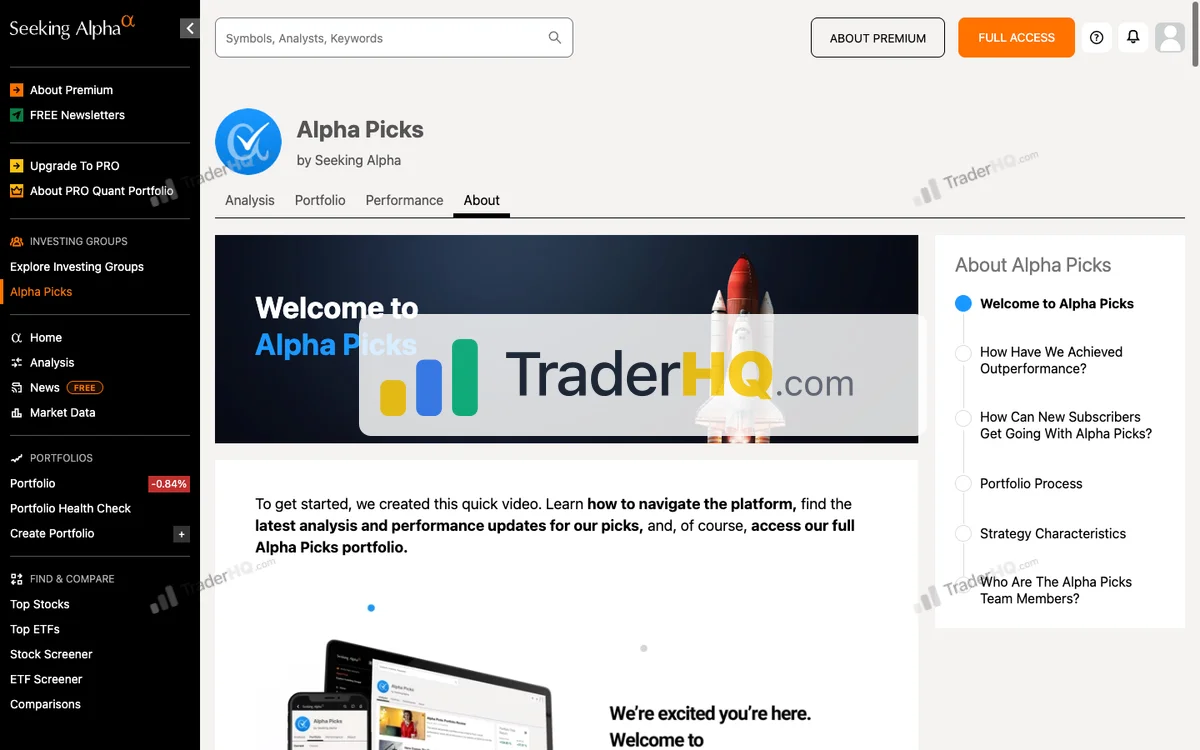
Seeking Alpha Alpha Picks is a pure quantitative stock-picking service that selects two stocks per month based on five factors: Value, Growth, Profitability, Momentum, and EPS Revisions. No analyst opinions. No narrative-driven picks. The algorithm scans US equities, identifies the highest-scoring candidates, and publishes them on the 1st and 15th of each month.
The Numbers That Matter
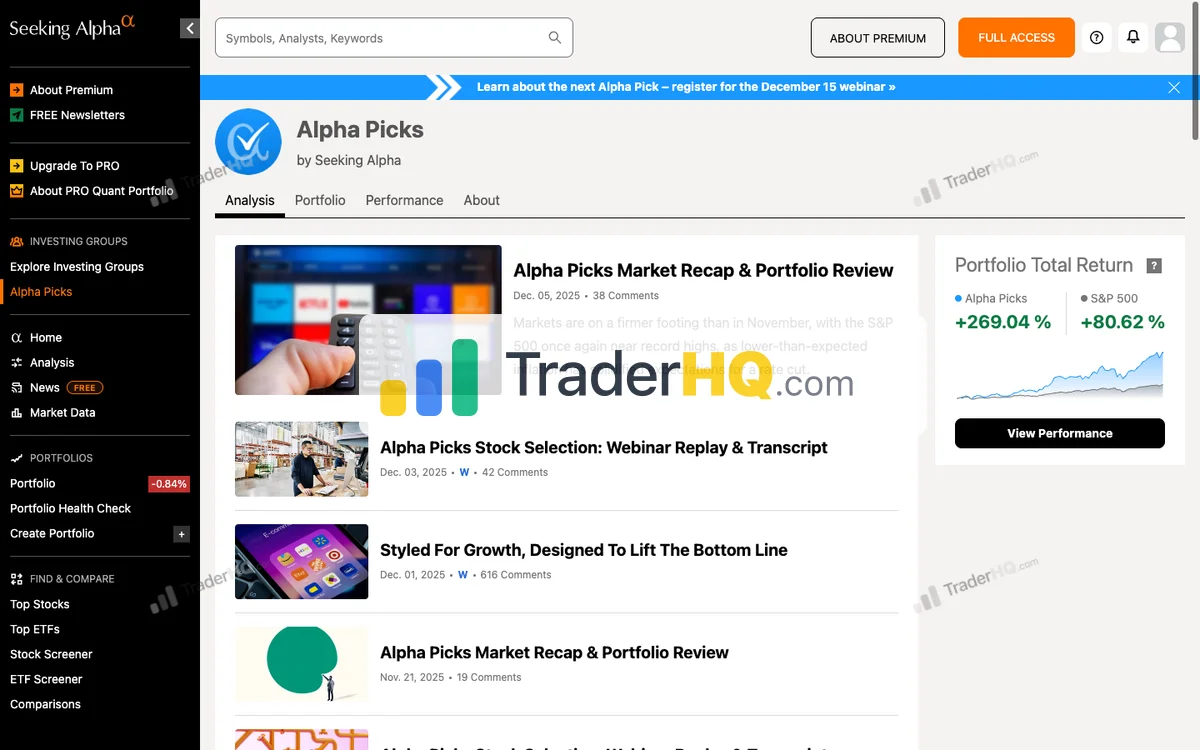
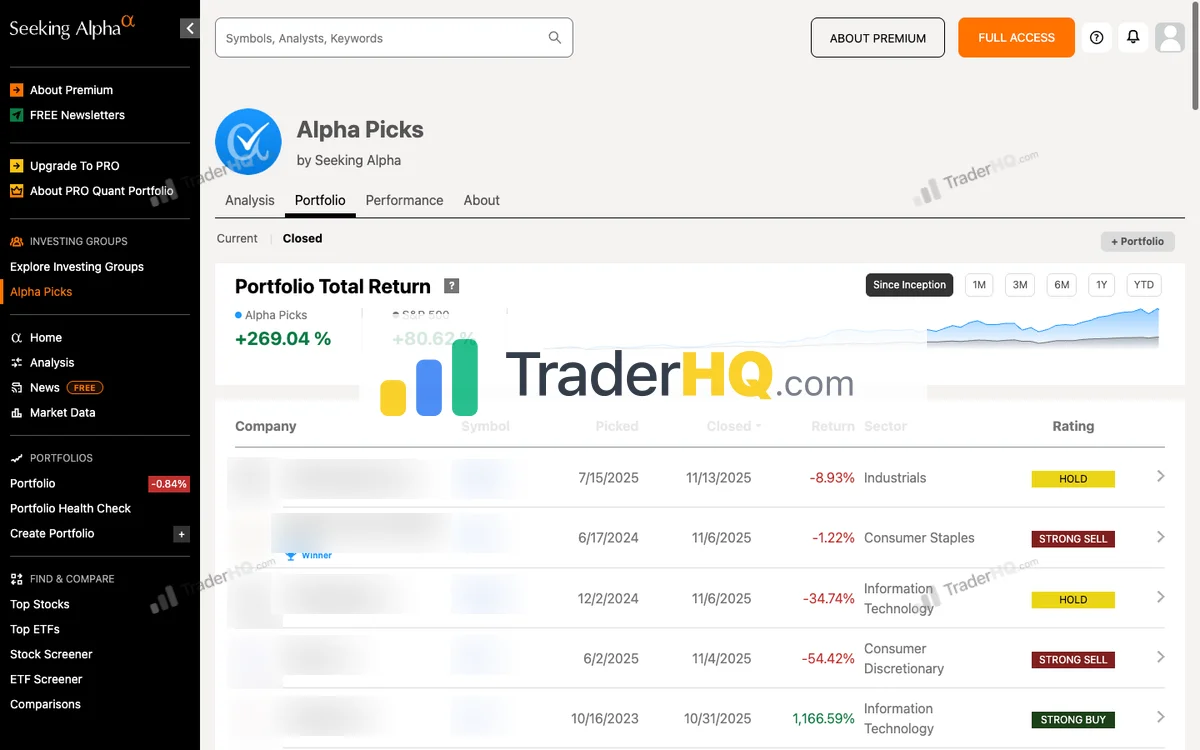
Since launching in July 2022, Seeking Alpha Alpha Picks has delivered +347.9% total returns versus +103.8% for the S&P 500 measured over each pick’s holding period (TraderHQ analysis of the published trade log, data as of September 1, 2026). That translates to a 43.3% compound annual growth rate. A $10,000 investment following every recommendation would be worth roughly $44,790 today.
The 104-position track record includes 3 ten-baggers (APP at +1,571%, CLS at +1,167%, SMCI at +969%), 21 stocks that doubled, and a 66% win rate overall. Even during the 2022 bear market, picks made during that downturn delivered an 82% win rate with +40.7% average returns.
But the headline numbers hide the most important insight: time transforms the results. Positions held under one year have won about half the time. Hold 1-3 years and the win rate jumps to 77.6% with +94.5% average returns. Selling every winner at +100% would have forfeited 61.5% of total returns.
Strengths
The transparency is exceptional. Every position is visible with entry dates, returns, and head-to-head comparisons against the S&P 500. The track record shows a stock up more than +1,570% right next to one down more than -54%. They do not hide the losers.
Re-recommended stocks average 251% returns versus 36% for single recommendations. When the model picks a stock twice, it is signaling high conviction through the only language a quant system speaks: data.
The systematic exit rules remove the emotional component of selling. When the quant rating drops to Sell or Strong Sell, the position gets closed. No second-guessing. No hoping for a recovery. For investors who have sold winners too early or held losers too long, this discipline has real value.
Limitations
The 4.2-year track record has only been tested through one bear market (2022). How the model performs through a prolonged recession or stagflationary environment remains unknown.
It is a black box. You know the five factors but not the weightings. You will not learn why Stock A scored higher than Stock B. For investors who want to build analytical capability, Seeking Alpha Alpha Picks tells you what to buy but not how to think.
No refunds. Annual billing only at $449-499. You are committing upfront with no trial period.
Best For: Data-driven investors with 1-3+ year horizons who trust systematic approaches and want verified, transparent performance data. See our Alpha Picks review for the full analysis.
Morningstar StockInvestor: 24 Years of Real-Money Moat Investing
Morningstar StockInvestor takes the opposite approach. Rather than algorithmic stock selection, it gives you access to two real-money model portfolios managed by Morningstar Investment Management using the firm’s proprietary economic moat methodology. Morningstar invests its own capital, nearly $945,000 in the Tortoise portfolio alone, and has been doing so since June 2001.
The Methodology
Morningstar StockInvestor is built on the economic moat framework that Morningstar pioneered: identifying companies with durable competitive advantages expected to last 10-20+ years. The five moat sources (Network Effect, Switching Costs, Intangible Assets, Cost Advantage, Efficient Scale) form the foundation for every portfolio decision.
Each position includes Morningstar’s proprietary ratings: star ratings for valuation, moat ratings for competitive advantage, fair value estimates from discounted cash flow models, and capital allocation ratings for management quality. When Morningstar StockInvestor buys Alphabet at a Price/Fair Value ratio of 0.66, you know exactly why: the stock trades at a 34% discount to Morningstar’s intrinsic value estimate.
The Two Portfolios
The Tortoise portfolio takes a value-oriented approach, investing in undervalued wide and narrow moat companies with strong balance sheets. Currently holding roughly 31 positions with Berkshire Hathaway (9.4%), Philip Morris (6.3%), and Meta Platforms (4.0%) among its largest holdings. Some positions date back to the 2001 inception. Michael Corty, CFA, manages it.
The Hare portfolio pursues growth-oriented moat investing. Managed by Grady Burkett, CFA, it accepts more volatility for higher return potential. The most recent addition was Airbnb in April 2025.
Strengths
The 24-year track record is the deepest in this comparison. Morningstar StockInvestor has navigated the dot-com aftermath, the 2008 financial crisis, the COVID crash, and the 2022 bear market. No newsletter survives 24 years without delivering value.
Real money invested creates genuine alignment. Paper portfolios can afford to hold through 40% drawdowns. When nearly $1 million of Morningstar’s own capital is at stake, portfolio decisions carry weight.
The educational depth is substantial. Each monthly issue includes stock spotlights with investment theses, fair value estimates, earnings commentary, and moat analysis. You learn to think in terms of competitive advantages and intrinsic value. That skill compounds long after you cancel any subscription.
Limitations
Morningstar StockInvestor does not publicly disclose specific performance returns versus its benchmark. The Tortoise portfolio benchmarks against the Morningstar US Target Market Exposure Index, but you will not find “we returned X% versus the index” on their marketing materials. For an investor comparing services, this makes apples-to-apples evaluation difficult.
Pricing is not transparently listed on the website. TraderHQ’s tracking lists ~$170/year, though comparable Morningstar newsletters suggest the true range may be $199-249/year. This lack of pricing clarity is unusual for a service targeting retail investors.
Portfolio turnover is low, which is a feature for tax-conscious long-term holders but a limitation for investors seeking frequent actionable ideas.
Best For: Long-term value investors with 5-10+ year horizons who want institutional-quality moat research, educational depth, and the discipline of following real-money portfolios.
Head-to-Head: What Actually Separates Them
Performance Transparency
This is the single biggest differentiator. Seeking Alpha Alpha Picks shows you every position: 104 picks, 69 winners, 35 losers, every entry date, every return, every comparison to the S&P 500. The +347.9% total return is TraderHQ analysis of the published trade log (data as of September 1, 2026).
Morningstar StockInvestor shows you complete portfolio tables with share counts, entry dates, and current values, but does not publish aggregate performance versus its benchmark. You can see that Alphabet was purchased in 2017 at a P/FV of 0.66, but you cannot see how the overall Tortoise portfolio has performed against the Morningstar US Target Market Exposure Index over 24 years.
For investors who need to see the numbers before committing, Seeking Alpha Alpha Picks makes the stronger case. For investors who trust Morningstar’s institutional reputation, the lack of published returns may not matter.
Investment Philosophy
Seeking Alpha Alpha Picks is factor-based and systematic. It scans for Value, Growth, Profitability, Momentum, and EPS Revisions. It does not care about competitive advantages or moats. It cares about quantitative scores. The holding period is medium-term (1-3 years), and exits are triggered by rating downgrades, not fundamental deterioration.
Morningstar StockInvestor is fundamentals-based and analyst-driven. It identifies economic moats, calculates fair values through DCF models, and buys when stocks trade below intrinsic value. Positions are held for years, sometimes decades. Exits happen when moats erode or valuations become excessive.
In September 2026’s market, CAPE at ~40-42, 210-point dispersion (top 20 at +168.7%, bottom 20 at -41.6%), and VIX at 14.92 create a defining test for both approaches. CPI ran at 3.4% YoY in July (BLS) — sticky and energy-driven, not solved. But the implications for the two approaches diverge:
For Seeking Alpha Alpha Picks’ quant approach, a September hike (odds near 60-65%) is the regime test — the model is untested in one. Its 2026 vintage runs a 38% win rate and -6% average return (TraderHQ analysis of the published trade log, data as of September 1, 2026) — a ★★★☆☆ situational fit.
The 2025 vintage caught Micron at +402.58%; APP’s -53.7% YTD slide shows what rotation costs. Dispersion still favors selection — but momentum works in both directions.
For Morningstar StockInvestor’s moat approach, the current environment is where fair value discipline earns its premium. With the Fed on hold at 3.50-3.75% and CAPE at its highest since 2000, wide moats and pricing power are resilience assets. Credit spreads at 2.60% further advantage quality moat companies with strong balance sheets.
Both approaches must navigate the same AI leadership split — memory and storage names up 162-560% YTD versus software and ad-tech down 20-64% — but they do so through fundamentally different lenses. Past performance does not guarantee future results for either.
Investor Development
This is where the comparison gets philosophical. Seeking Alpha Alpha Picks gives you fish. Morningstar StockInvestor teaches you to fish.
Following Seeking Alpha Alpha Picks for three years, you will have better returns (probably) but no deeper understanding of why any specific stock was selected. The algorithm does the thinking. You follow. That is a feature for some and a limitation for others.
Following Morningstar StockInvestor for three years, you will understand economic moats, fair value estimation, and capital allocation analysis. Even if you eventually cancel, the framework stays with you. You can evaluate any stock through the moat lens.
For investors building a lifetime of wealth, analytical capability compounds alongside capital. Morningstar StockInvestor builds that capability. Seeking Alpha Alpha Picks bypasses it entirely.
Cost and Commitment
Seeking Alpha Alpha Picks costs $499/year (MSRP) or $449/year (promotional price). No refund. Annual billing only.
Morningstar StockInvestor is listed at ~$170/year. The pricing is not prominently displayed on their website. Refund policy requires contacting customer service.
At roughly 3x the price, Seeking Alpha Alpha Picks needs to justify the premium through results. Based on the 43.3% CAGR, even a modest portfolio benefits. One avoided mistake on a $5,000 position saves more than the subscription. But the premium works if you follow the system and hold through the 1-3 year timeframe where the win rate reaches 77.6%.
How to Decide
Choose Seeking Alpha Alpha Picks if:
- You want verified, documented performance data before subscribing
- You trust systematic, quantitative approaches over human judgment
- Your investment horizon is 1-3 years per position
- You prefer being told what to buy without needing to understand the full thesis
- You have $25,000+ to deploy across 20-40 positions
Choose Morningstar StockInvestor if:
- You plan to hold positions for 5-10+ years and value decades of real-money proof
- You want to develop moat-based analytical skills that last a lifetime
- Cost sensitivity matters (roughly $170/year vs $449-499/year)
- You trust Morningstar’s institutional research even without published aggregate returns
- You want portfolio construction guidance, not just individual picks
Either works if:
- You will actually follow the recommendations rather than second-guessing the service
- You understand that no stock-picking service wins on every pick
- You treat the subscription as one input to your investment process, not your entire strategy
The Tiebreaker: Ask yourself what matters more: seeing the exact return number on every position, or understanding why a company has a durable competitive advantage. If it is the number, go with Seeking Alpha Alpha Picks. If it is the framework, go with Morningstar StockInvestor.
The Bottom Line
Seeking Alpha Alpha Picks wins for most investors. The +347.9% documented returns versus +103.8% for the S&P 500, the 66% win rate, and the complete transparency on all 104 positions give you something concrete to evaluate. In a market with 210-point dispersion between winners and losers, a systematic approach that has demonstrated the ability to capture alpha on the right side of that spread deserves serious consideration.
But Morningstar StockInvestor is the better choice if you are building for decades, want to develop genuine analytical capability, or prefer the discipline of following a 24-year real-money portfolio. The moat framework that Morningstar pioneered has shaped how a generation of investors thinks about competitive advantage. That intellectual foundation has value that transcends any single year of returns.
Both services reward patience and punish impulsiveness. The most important variable is not which service you choose. It is whether you follow it.

Alpha Picks by Seeking Alpha Performance
Seeking Alpha · 104 picks · 4 years · Updated 2026-09-01
| AP Return | S&P 500 | Alpha | Win Rate |
|---|---|---|---|
| +348% | +104% | +244% | 66% |
S&P 500 shows what you'd have earned buying the index on each pick date instead. Same timing, fair comparison.
| AP Multi-Baggers | 10x+ | 5x+ | 3x+ | 2x+ |
|---|---|---|---|---|
| Count | 1 | 4 | 12 | 19 |
| AP Asymmetry | Avg Winner | Avg Loser | Ratio |
|---|---|---|---|
| Return | +122% | -22% | ~6:1 |
Best Performers (All-Time)
| AP Pick | Return |
|---|---|
**** Thermal Management | +348% |
**** Memory Chips | +403% |
**** Casual Dining | +346% |
 POWL Powell Industries | +887% |
**** Power Plant Construction | +357% |
 STRL Sterling Construction | +653% |
 SMCI Super Micro Computer | +969% |
 CLS Celestica | +1.2K% |
**** Homebuilder | +228% |
 APP AppLovin | +1.6K% |
Latest Alpha Picks Picks
Tickers masked to protect subscriber value. Recent picks need 3-5+ years to demonstrate thesis.
| AP Pick | Return |
|---|---|
**** Memory Chips | +403% |
**** Circuit Board Manufacturing | +102% |
**** Growth Company | +75% |
**** Growth Company | +74% |
**** Gold Mining | +44% |
**** Growth Company | +42% |
**** Growth Company | +26% |
**** Growth Company | +26% |
**** Connectivity Chips | +26% |
**** Growth Company | +11% |
Alpha Picks Win Rate by Holding Period
| Hold Time | AP Win Rate | Avg Return |
|---|---|---|
| < 1 Year | 47.6% | +10% |
| 1-3 Years | 77.6% | +95% |
| 3-5 Years | 100% | +437% |
| 5-10 Years | N/A% | N/A |
| 10+ Years | N/A% | N/A |
Alpha Picks Performance by Year
| Year | AP Picks | Avg Return | Win Rate | |
|---|---|---|---|---|
| 2026 | 16 | -6% | 38% | LITE+42% |
| 2025 | 24 | +59% | 75% | MU+403% |
| 2024 | 24 | +65% | 67% | EAT+346% |
| 2023 | 24 | +155% | 71% | CLS+997% |
| 2022 | 16 | +65% | 75% | MOD+348% |
Inside Alpha Picks
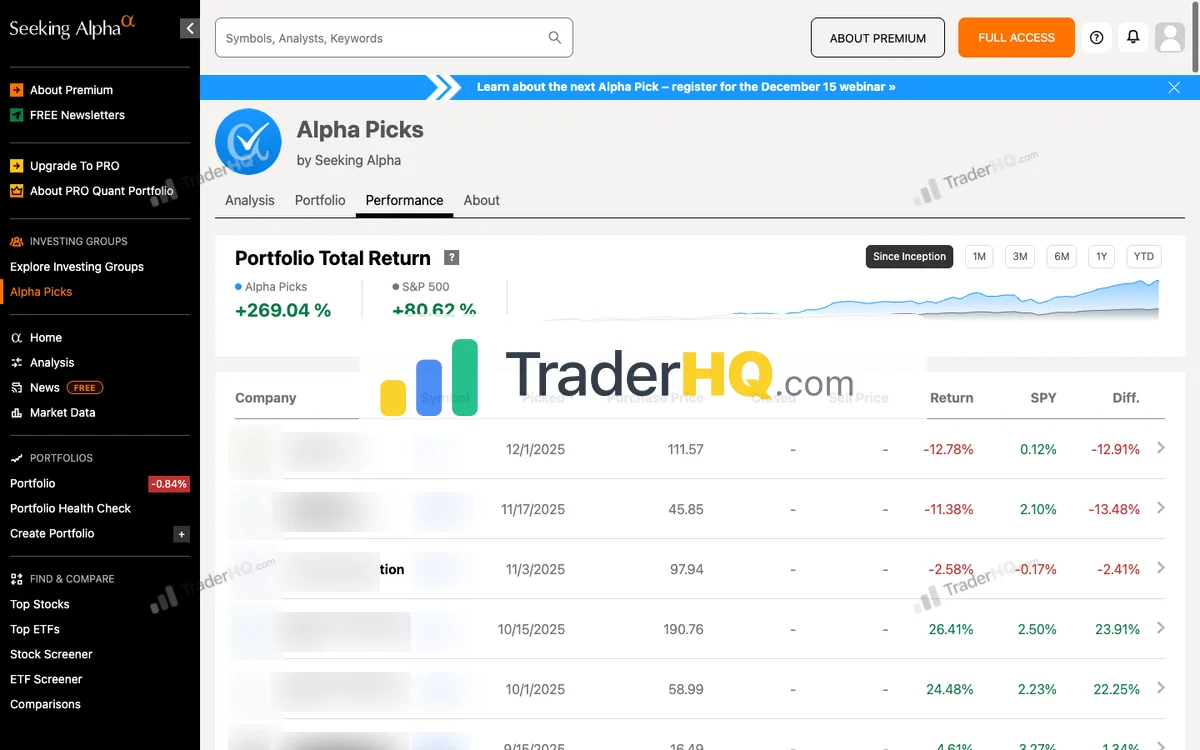
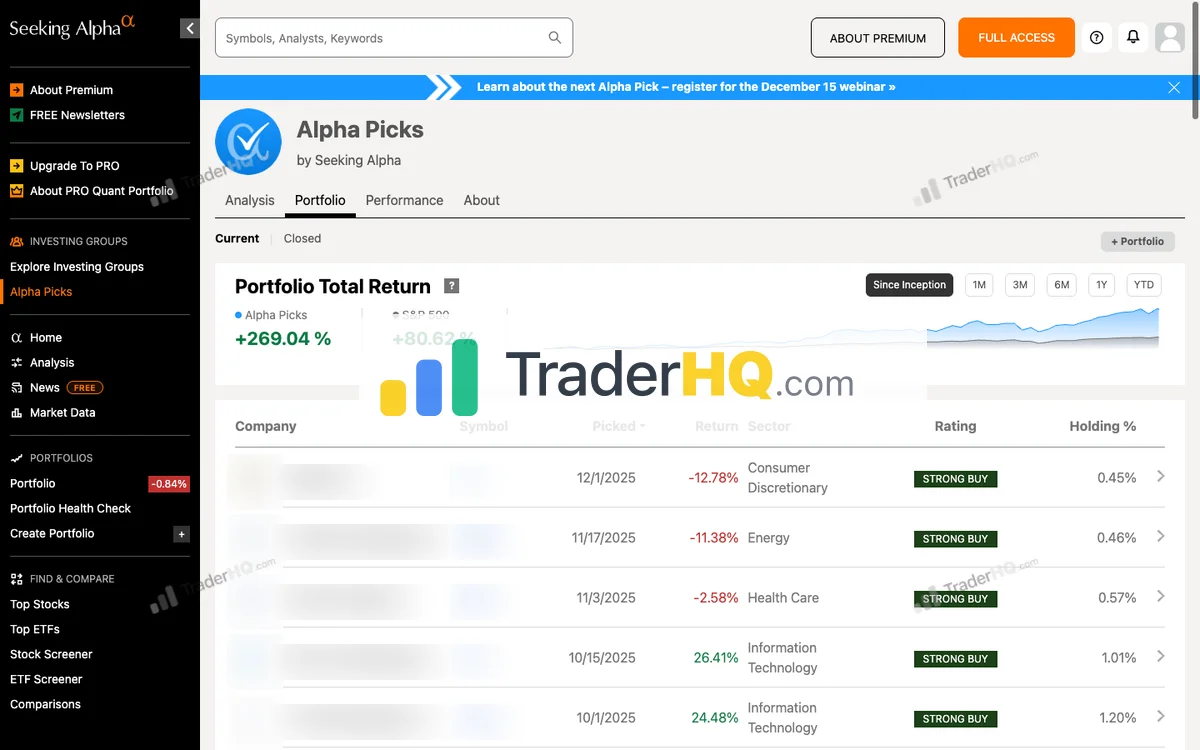

6 screenshots · Click to expand
Frequently Asked Questions
Seeking Alpha Alpha Picks vs Morningstar StockInvestor: which is better?
Seeking Alpha Alpha Picks is better for most investors because it provides fully documented performance data (+347.9% since 2022, 66% win rate) and complete transparency on every position. Morningstar StockInvestor is better for long-term value investors who want a 24-year real-money moat methodology and educational depth. Seeking Alpha Alpha Picks costs $499/year versus ~$170/year for Morningstar StockInvestor, but the documented returns justify the premium for investors who can hold 1-3+ years. Past performance does not guarantee future results.
Is Seeking Alpha Alpha Picks worth it?
Yes, for investors who can commit to 1-3+ year holding periods. Seeking Alpha Alpha Picks has delivered +347.9% total returns since July 2022 versus +103.8% for the S&P 500 (per-position benchmark), with a 66% win rate across 104 documented positions (TraderHQ analysis of the published trade log, data as of September 1, 2026). The critical insight is the time curve: under-one-year picks have won about half the time, while 1-3-year picks reach a 77.6% win rate with +94.5% average returns. At $499/year, even one avoided mistake on a $5,000 position covers the subscription cost.
Is Morningstar StockInvestor worth it?
Yes, for long-term value investors who want institutional-quality research. Morningstar StockInvestor provides access to two real-money model portfolios (Tortoise and Hare) that have been actively managed since June 2001. At ~$170/year, you get Morningstar’s proprietary moat ratings, fair value estimates, and capital allocation scores that typically require institutional subscriptions costing $15,000+/year. The limitation is that specific performance returns versus the benchmark are not publicly disclosed.
Can I use both Seeking Alpha Alpha Picks and Morningstar StockInvestor together?
Yes, and they complement each other well. Seeking Alpha Alpha Picks provides medium-term quant-driven picks (1-3 year horizon) based on factor scoring, while Morningstar StockInvestor provides long-term fundamental analysis based on economic moats (5-10+ year horizon). Using both gives you systematic stock selection plus a fundamental framework for evaluating quality. The combined cost would be approximately $619-669/year.
Does Morningstar StockInvestor beat the market?
Morningstar StockInvestor does not publicly disclose aggregate performance returns versus its benchmark (the Morningstar US Target Market Exposure Index). The Tortoise portfolio has been actively managed since June 2001 with nearly $945,000 of Morningstar’s own capital invested. Some positions, including Berkshire Hathaway, have been held since inception. The 24-year survival and continued real-money investment suggest the methodology has delivered value, but specific return figures are not available for independent verification.
How does Seeking Alpha Alpha Picks select stocks?
Seeking Alpha Alpha Picks uses a pure quantitative model that scores US equities across five factors: Value, Growth, Profitability, Momentum, and EPS Revisions. Stocks must maintain a “Strong Buy” quant rating for at least 75 consecutive days, have a $500M+ market cap, and trade above $10. Two picks are published monthly on the 1st and 15th. No human discretion overrides the model. Performance is independently calculated by S&P Global using standards consistent with GIPS.